

Your Chat Has a Budget You Cannot See #174
A frontier class model got 50 percent cheaper this week. The bigger change was a single line about caching that decides what your conversations actually cost.
We are honored to count you among the >600.000 readers of “DIGITAL STORM weekly” across our platforms. Please help grow our community by inviting your friends.

Your call to join the world’s first Claude-athon happening LIVE this weekend

Did you know that 87,714 people lost their jobs to AI this year. Meanwhile Fortune 500 companies are paying a 62% salary premium to people with AI skills. Currently Claude is the competitor out there, outdoing every job you can do in seconds, but you can use it to your advantage to be the smartest and fastest in the room by making it your 2nd brain.
We recommend you to join the world’s first Claude-athon by outskill hosted by mentors who have condensed 800+ hours of Claude research, articles, YouTube content and real-world practice into a focused 16-hour curriculum.
You will learn how to:
master Claude’s three modes : Chat, Cowork and Code.
Set up Skills, Connectors and Plug-ins to automate your desktop, Notion and files.
Vibe code apps and dashboards without writing code & 10+ AI tools and workflows that pair with Claude.
GET AI EQUIPPED NOW! 🧠 Saturday & Sunday - 🕜 10 AM – 7 PM EST
Our AI Podcast with Chief Transformation Officer ServiceNow
Many companies believe better AI models will solve their transformation challenges. Dirk Ramhorst argues the real bottleneck is organizational readiness.
In this episode of the Digital Storm Weekly Podcast, we spoke with Dirk Ramhorst, Chief Transformation Officer at ServiceNow, about why enterprise AI is shifting from copilots to autonomous agents, and why governance, workflows, and leadership will determine who succeeds. One of his strongest messages:
AI doesn’t create business value until it’s embedded into real workflows.
Some key insights from Dirk:
AI agents move beyond recommendations to autonomous execution
Governance becomes more important as AI scales across the enterprise
Organizations should measure business outcomes, not pilot counts
Change management often costs more than the technology itself
Competitive advantage will come from operationalizing AI, not adopting it
If you’re responsible for AI strategy, enterprise technology, or business transformation, this episode provides a practical perspective on what it really takes to scale AI successfully.
🔗 YouTube – Amazon Music – Apple Podcasts – Spotify – RSS
On 24 July, Anthropic released Claude Opus 5 at half the input price of its frontier sibling.
Every roundup led with that number. Almost nobody led with the two beta features buried at the bottom of the same announcement, and those are the ones that change how you should work on Monday.
Here is the part that gets missed. Your model does not remember your conversation. It re reads it. Every single turn, from the top. That one mechanical fact quietly governs three things at once: how good the answers get, how much the session costs, and which data retention regime your input falls under. Most people are managing exactly one of those three, and usually the wrong one.
What you will learn in this issue
Why a long conversation gets worse, not just more expensive, and the architectural reason behind it
How to read the real price of a Claude session: the cache line, not the sticker price
Why correcting a bad answer is the most expensive way to fix it, and what to do instead
How to route any task to the right model tier in under 60 seconds
Why picking a model is now a data governance decision, not only a quality one
Keep this free. This briefing stays open because readers forward it. If you know someone running a 200 turn chat and wondering why the answers got vague, this is the issue for them.
The Big AI Shift
Half price was the headline. Cache was the story.
What changed, and when. On 24 July 2026 Anthropic released Claude Opus 5. It is priced at 5 dollars per million input tokens and 25 dollars per million output tokens, the same as Opus 4.8 and half the input price of Fable 5. Anthropic describes it as coming close to Fable 5 frontier intelligence at half the price, and it became the new default model on Claude Max and the strongest model available on Claude Pro.
The evidence. Anthropic reports Opus 5 as state of the art on coding and knowledge work evaluations including Frontier Bench and GDPval AA, with performance on CursorBench 3.2 landing within 0.5 percent of Fable 5 at maximum effort while costing roughly half per task. On the computer use benchmark OSWorld 2.0, Anthropic says Opus 5 beat Fable 5 best result at just over a third of the cost.
Why the obvious reading is incomplete. A price cut is a procurement event. It changes a line in a spreadsheet. What actually changes how you work sat two thirds down the same page, in a short list marked beta:
The two lines nobody quoted
Mid conversation tool changes. Inside a conversation, developers can now change which tools Claude can use without invalidating the prompt cache.
Automatic fallbacks. Requests flagged by safety classifiers on Opus 5 or Fable 5 can now route automatically to another model instead of being blocked. In Claude.ai, Claude Code and Claude Cowork, flagged Opus 5 requests fall back to Opus 4.8 by default.
Both are about the same underlying thing: keeping a working session alive and cheap instead of restarting it.
By the end of this issue you will understand why those two lines are worth more to your weekly workflow than the 50 percent discount, and you will have a one page rule for deciding which model sees which task.
The Teaching Chapter
The Attention Budget
The shift
For three years the skill everyone chased was prompting. Write the magic words, get the magic answer. That skill has not disappeared, but it has been demoted. The higher leverage skill now is deciding what is allowed into the conversation at all, and Anthropic has been unusually direct about why.
How it works
Three mechanics, stacked.
One: nothing is remembered, everything is resent. A language model has no memory between turns. When you send message 40, the entire transcript of messages 1 through 39 is submitted again alongside it. The conversation is not stored on the model side and referenced. It is re read.
Two: attention is finite and every token spends it. Anthropic engineering describes this plainly in its context engineering guidance: models have an attention budget, every new token depletes some of it, and context must be treated as a finite resource with diminishing marginal returns. The reason is architectural. Transformers let every token attend to every other token, which produces n squared pairwise relationships for n tokens. As the context lengthens, the model ability to hold all those relationships gets stretched thin.
Three: recall degrades before anything visibly breaks. Anthropic cites needle in a haystack research on what is now called context rot: as the number of tokens in the context window rises, the model ability to accurately recall information from that context falls. Anthropic is careful to note this is a performance gradient rather than a hard cliff. Nothing errors. Nothing warns you. The answers just get a little vaguer, a little more generic, a little more likely to relitigate something you settled twenty turns ago.
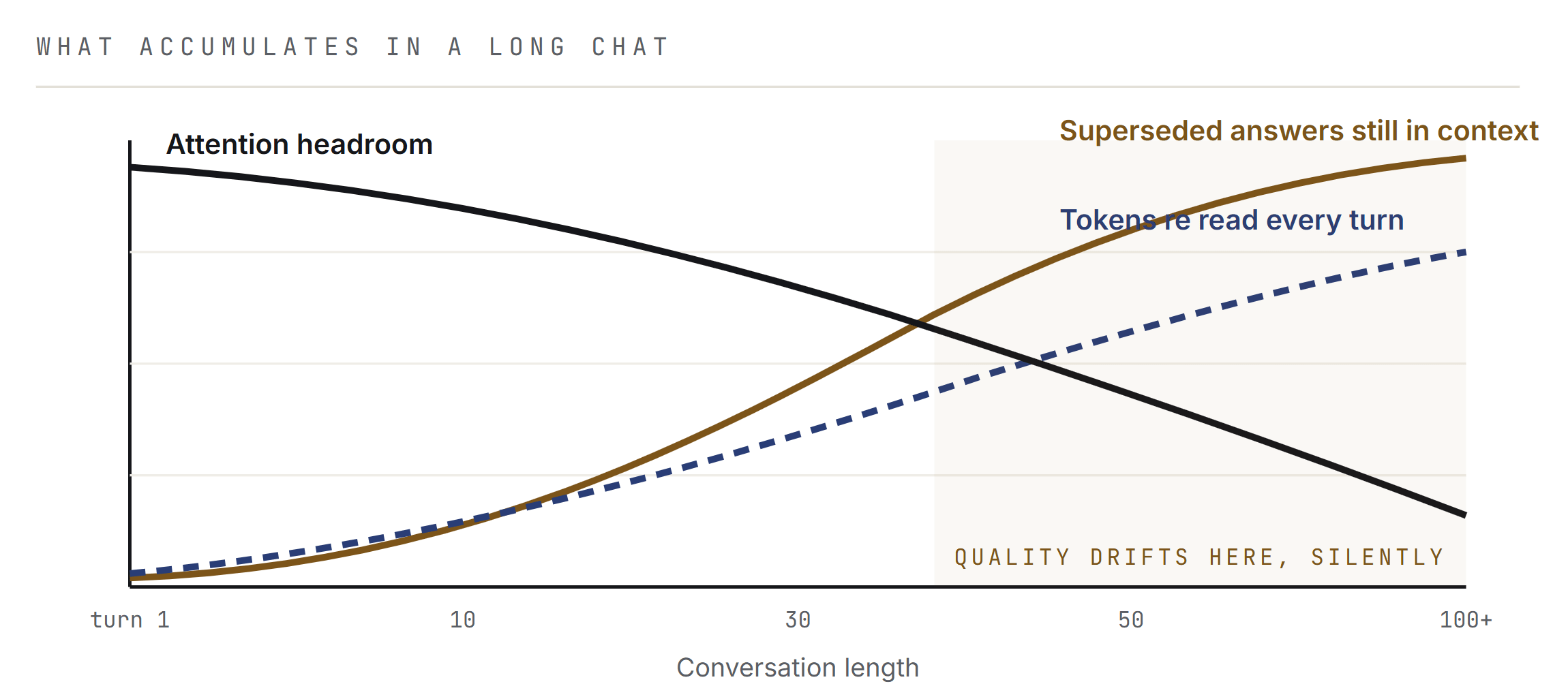
The analogy that makes it click
Picture a meeting room with one whiteboard that is never erased.
Meeting one, the board is clean and the discussion is sharp. By meeting thirty the board holds every crossed out proposal, every abandoned direction, every number somebody corrected. The rule of this room is brutal: before anyone may speak, everyone must silently read the entire board from the top.
Adding a line costs almost nothing. Reading the board again costs the same as it always did, every time, forever. And by meeting forty, the one decision that actually matters is somewhere in the middle, in handwriting that looks exactly like the nine decisions you reversed.
Now the important bit, and this is where the analogy earns its keep: crossing something out does not remove it from the board. When you tell the model “no, that was wrong”, the wrong answer stays in the transcript and gets re read on every future turn, now accompanied by your correction. You have not deleted a distractor. You have added a second one.
Explain it simply
The model does not remember your chat. It rereads the whole thing before every reply. That means a long conversation costs more per message and gets less precise, because attention is limited and old material competes with new instructions. The fix is not a better prompt. The fix is a shorter, cleaner conversation with the wrong turns removed rather than corrected.
Worked example: what turn 40 actually costs
All prices below are the published Claude Platform rates for Opus 5 as of 30 July 2026. Token counts are a transparent estimate for a realistic working session, not a measurement.
Setup. A strategy session. Forty turns in, the transcript plus attached briefing documents runs roughly 120,000 tokens.
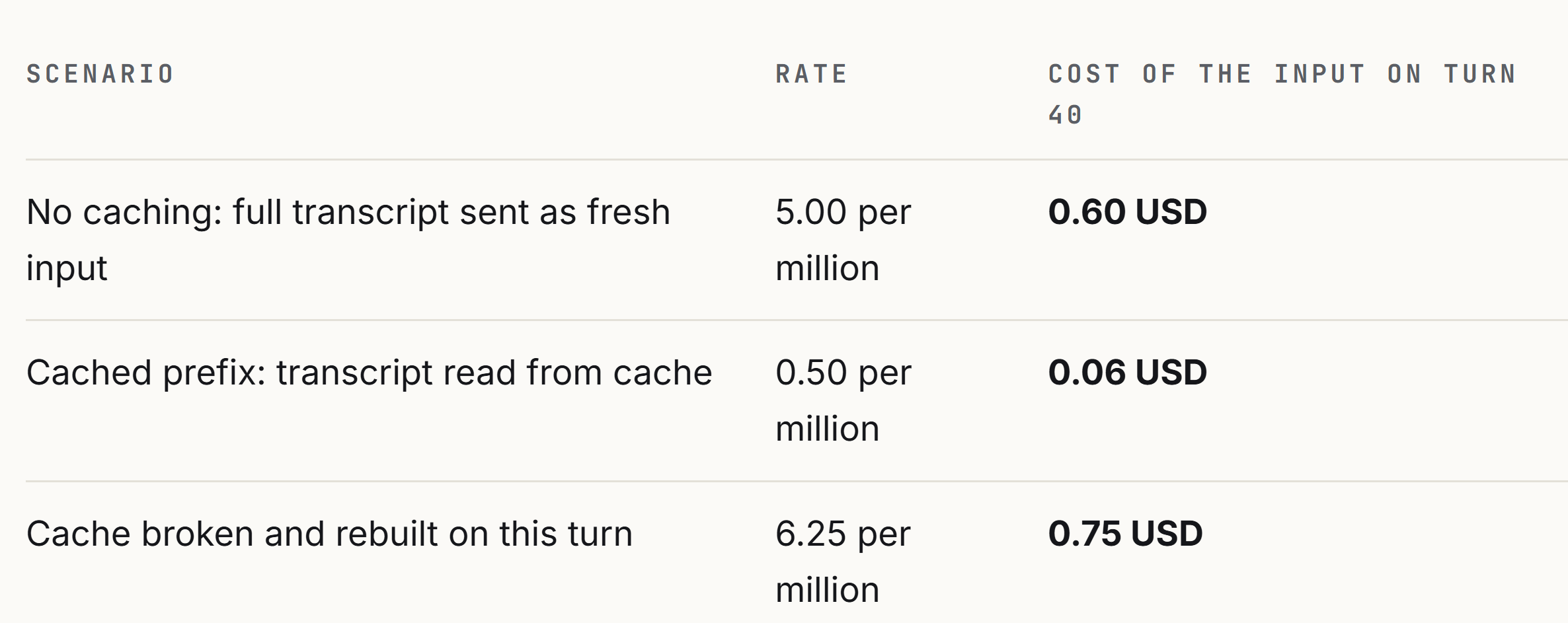
Interpretation. A cache read costs one tenth of fresh input. That is the whole game. A conversation that keeps its cache warm is roughly ten times cheaper to continue than one that does not, and a conversation that breaks its cache pays more on that single turn than an uncached turn would have cost in the first place.
So what breaks the cache? Changing the front of the prompt. Historically that included changing which tools were available mid conversation, which is why toggling a connector halfway through a session was quietly expensive. That is precisely the thing Anthropic changed on 24 July: tool changes inside a conversation no longer invalidate the prompt cache. A workaround people were trading as folklore became a platform behaviour.
A cache read costs ten percent of fresh input. Everything you do to a conversation either protects that discount or destroys it.
The part that surprises most people
The cheapest way to fix a bad answer is to delete it, not to correct it.
In the Claude interface, editing one of your earlier messages does not just resend it. It creates a new conversation branch, and the app tells you so, with arrow navigation to switch between branches. The turns after the edited message no longer sit in the context of the new branch.
Compare the two repair strategies on a 40 turn session:
Correct in place. The bad answer, your correction, and every subsequent turn all stay in context and get re read on turn 41, turn 42, turn 43. You pay for the mistake permanently, in both tokens and attention.
Edit and branch. You go back to the prompt that produced the bad answer, sharpen it, and save. The bad answer never enters the new branch at all. The context gets shorter and cleaner at the same time.
Most people never use the edit affordance because it looks like a typo fix. It is not. It is the closest thing the interface has to an undo for context.
Common mistake
Treating the context window as storage. It happens because the number looks like a capacity. Claude Free, Pro, Max and Team plans run a 200k context window; Enterprise runs 500k on the default model. People read those as “how much I can put in” and try to fill them.
Anthropic guidance points the other way: good context engineering means finding the smallest possible set of high signal tokens that maximise the likelihood of the outcome you want. The window is a working surface, not a filing cabinet. The right question is never “will this fit”, it is “does this earn its place”.
The practical rule
One conversation, one job. When the job changes, the conversation ends.
Not “start a new chat when it feels slow”. That is a lagging indicator, and by the time a session feels slow you have been getting quietly worse answers for a while. Use the change of job as the trigger, because you always know when the job changed.
What most people miss
Here is the second order effect, and it is the reason this belongs on an executive agenda rather than a productivity blog.
Choosing a model is now a data governance decision.
The Opus 5 announcement contains one sentence that is easy to skim past: consistent with prior Opus models, Opus 5 does not have data retention requirements for general access. That sentence exists because the frontier tier is different. Anthropic documentation states that Claude Fable 5 and Claude Mythos 5 require 30 day data retention and are not available under zero data retention arrangements. The policy took effect on 9 June 2026 and applies to organisations running zero retention workspaces in the Console, Claude Code with zero retention in Claude Enterprise, and access through AWS Bedrock, Google Cloud and Microsoft Foundry with zero retention.
Two clarifications, because this story has been reported badly in both directions. Consumer plans, meaning Free, Pro and Max, are explicitly unaffected, since inputs and outputs were already retained there. And zero retention agreements remain intact for the non Mythos models. This is a carve out at the top of the range, not a blanket change.
Which produces a situation almost nobody has written into policy: the same prompt, pasted into the same product, lands under a different retention regime depending on which name is showing in the model picker. If your team drafts client material, that dropdown is a compliance control that currently has no owner.
What to remember
Every turn re reads everything. Length is not free, and it costs quality before it costs money.
Remove, do not correct. Editing an earlier message branches the conversation and takes the mistake out of context entirely.
The model picker is a governance control. Route by data sensitivity first, difficulty second.
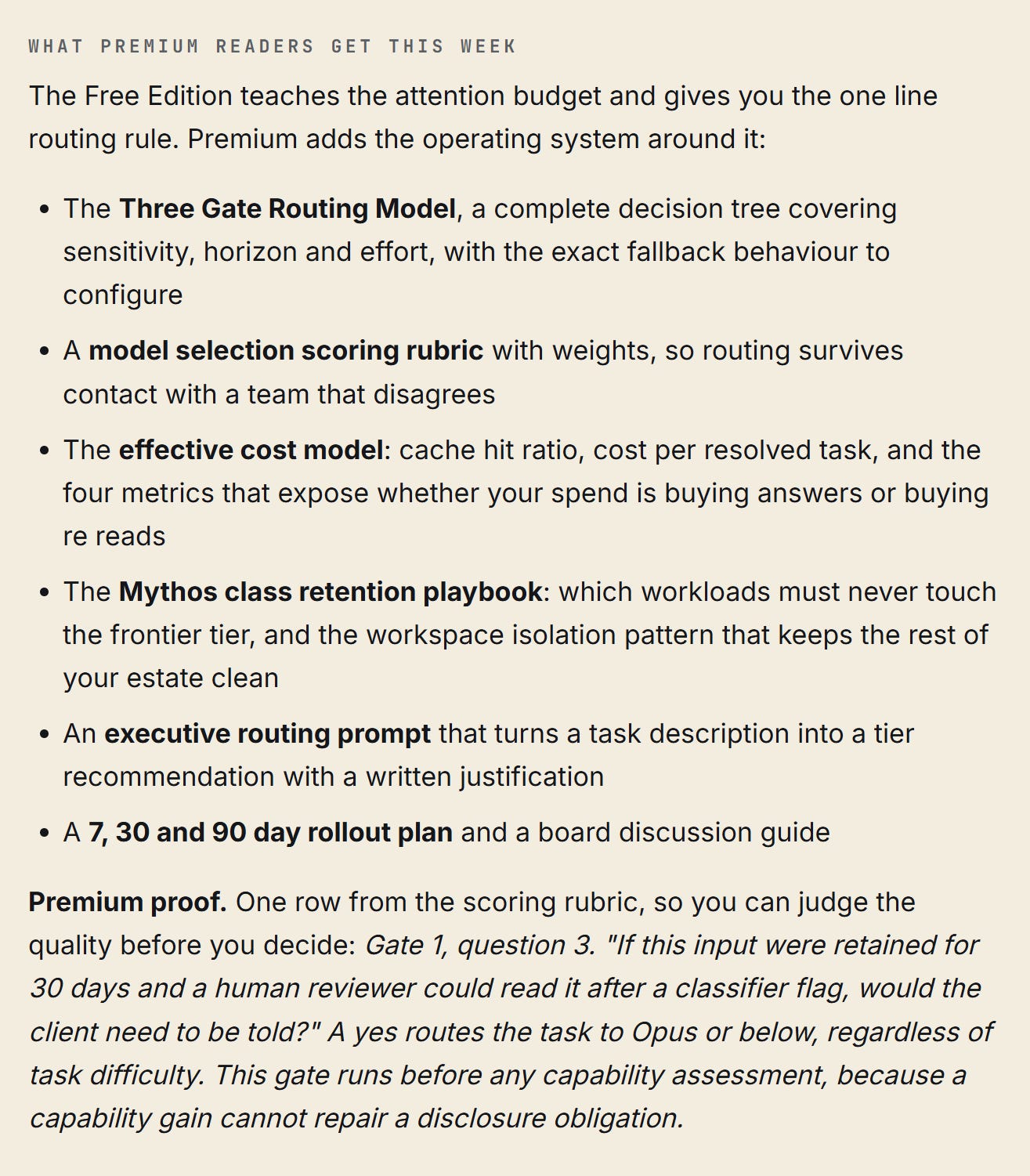
What Premium readers get this week
AI Term in 60 Seconds
Prompt cache read
When you send a conversation, the unchanged front portion of it can be served from a cache instead of processed fresh. A cache read is billed at a fraction of the input rate: for Opus 5, 0.50 per million against 5.00 per million. Writing to the cache costs more than fresh input, at 6.25 per million, which is why breaking a cache is worse than never having had one. Anything that changes the beginning of the prompt invalidates it. Published rates reflect a five minute cache lifetime.
Why you care even if you never touch the API: the same economics shape your usage limits inside the app. Long, frequently disturbed conversations consume your allowance faster than short focused ones doing the same work.
AI Tutorial
Build your routing card in 25 minutes
Objective. Produce a single page card that tells you, or anyone on your team, which model tier and effort level to use for any recurring task, and why.
Intended reader. Anyone who uses Claude more than three times a week, or who is responsible for people who do.
Required tools. Claude on any paid plan. A blank document. Nothing else.
Effort. 25 minutes, once. Review quarterly.
Preparation
Open your Claude history and list the ten tasks you actually repeat. Not the impressive ones. The recurring ones: weekly summaries, first draft emails, spreadsheet cleanups, code review, meeting prep, research triage.
Step by step
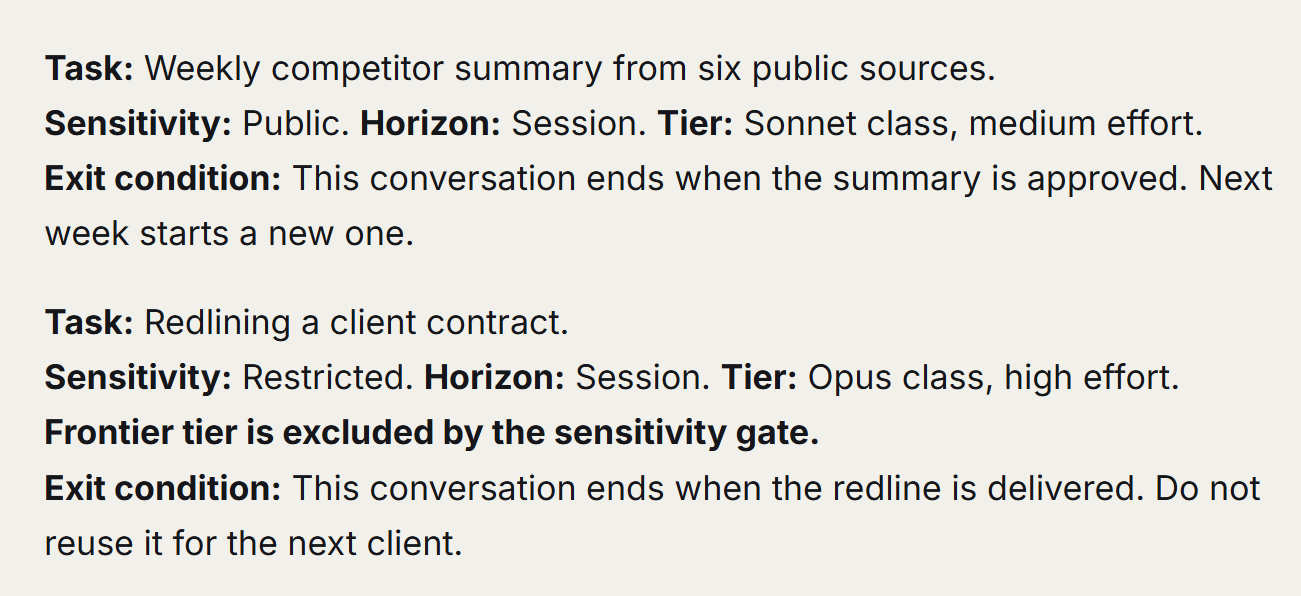
Classify each task by data sensitivity. Three buckets only. Public means you would post it. Internal means colleagues only. Restricted means client confidential, personal data, legal or regulated. Do this first and do it fast; ambiguity means restricted.
Classify each task by horizon. Single shot is one question, one answer. Session is a working conversation under roughly 20 turns. Long running is agentic work with heavy tool use across many steps.
Assign a tier. Restricted never routes to the frontier tier. Single shot and routine work routes to the fastest adequate model. Long running agentic work routes up, because failure and retry cost more than the token difference.
Set an effort level. The Claude interface exposes effort alongside the model, from low through to max, with High as the default. Higher effort produces more thorough responses but takes longer and consumes your limits faster. Assign the lowest effort that has ever been good enough for that task, not the highest you can afford.
Write the exit condition. For each task, one sentence: “this conversation ends when ___”. This is the line that protects your attention budget, and it is the one everybody skips.
Test the card against last week. Take three real conversations from the past seven days and check what the card would have told you. If the card would have been wrong, the card is wrong, not the conversation.
Example input and output
Common mistakes
Assigning the strongest model to everything. This is the expensive habit that feels like diligence.
Writing sensitivity buckets that need a lawyer to apply. If your team cannot classify a task in five seconds, the card will be ignored.
Skipping the exit condition, which is the only part of the card that actually shortens conversations.
Quality control checklist
Every task has all four fields filled: sensitivity, horizon, tier, exit condition
At least two tasks route down from where you have been routing them
At least one task is explicitly excluded from the frontier tier on sensitivity grounds
The whole card fits on one page and needs no explanation
Expected result and transfer
You end with a one page card and, typically, the discovery that two or three tasks have been running on an unnecessarily expensive tier out of habit. The transferable skill is the sequencing: sensitivity before capability. The same order works for vendor selection, for which documents go into a shared project, and for which parts of a workflow you are willing to hand to any autonomous agent.
Mega Prompt of the Week
The Context Audit
Paste this into any long conversation that has started to feel mushy. It produces a clean restart brief so you can close the session without losing what it earned.
ROLE
You are a context auditor. You are ending this conversation on purpose and
your only job is to make the next one shorter and sharper than this one was.

OBJECTIVE
Produce a restart brief that lets a fresh conversation reach the current
state of this work in one message, carrying forward only what is load bearing.

REQUIRED INPUTS
Use only this conversation. Do not search. Do not add outside knowledge.
If something needed is missing, list it under OPEN QUESTIONS rather than
inventing it.

CONSTRAINTS
- Maximum 400 words total.
- No pleasantries, no preamble, no summary of the summary.
- Every line must be something the next conversation cannot proceed without.
- Preserve exact figures, names, file references and constraints verbatim.
- Discard: superseded answers, abandoned directions, tool output already
  acted on, and anything I asked you to disregard.

PROCESS
1. Identify the current objective as it stands now, not as originally stated.
2. List decisions already made and locked. Mark each LOCKED.
3. List constraints that still bind, including things I said I dislike.
4. List what has been tried and failed, with one clause on why it failed.
   This is the highest value section: it stops the next conversation
   repeating the same dead end.
5. List the immediate next action.
6. List open questions that need my input.

OUTPUT FORMAT
OBJECTIVE (1 sentence)
LOCKED DECISIONS (bullets)
BINDING CONSTRAINTS (bullets)
FAILED APPROACHES AND WHY (bullets)
NEXT ACTION (1 sentence)
OPEN QUESTIONS (bullets, or "none")

QUALITY CHECKS
Before returning, verify:
- Would someone with zero knowledge of this chat know what to do next?
- Have I included anything that is merely interesting rather than necessary?
  Delete it.
- Are all numbers and names exactly as they appeared, not paraphrased?

FAILURE CONDITIONS
If this conversation contains no locked decisions, say so plainly and
recommend continuing here instead of restarting. Do not manufacture
structure that the conversation does not have.
Why it works
It names the discard list explicitly. Compression prompts usually specify what to keep. Specifying what to throw away is what actually shrinks the output, because the model otherwise defaults to being comprehensive.
It protects failed approaches. Anthropic default compaction summary prompt preserves failed approaches for the same reason: a restart that forgets what did not work will confidently retry it.
It has a failure condition. Prompts that cannot fail produce confident output on empty input. This one is allowed to say the restart is unnecessary.
Best suited to: the Opus tier, which is strong at verification and holding a long thread. Adapt by changing the word limit, or by adding “and list every file path referenced” for coding sessions.
Image Prompt of the Week
The board that was never erased

Subject: a single long whiteboard in an empty modern meeting room,
completely covered edge to edge in overlapping handwritten notes, crossed
out lines, diagrams drawn over older diagrams, and faded ghost marks from
writing that was never fully erased.

Scene: late afternoon, empty chairs pushed back, one clean eraser resting
untouched on the tray. No people.

Composition: wide horizontal, whiteboard occupying the left two thirds,
generous empty wall on the right for headline text. Camera at seated eye
level, slightly off centre, gentle one point perspective drawing the eye
along the board from left to right.

Visual hierarchy: the density gradient is the subject. Sparse and legible
at the far left, illegible palimpsest by the right edge of the board.

Lighting: low warm daylight from an off frame window at the left,
raking across the board surface so older marks catch a faint sheen.

Style: restrained editorial photography, documentary rather than staged.
Colour palette: warm off white, graphite grey, muted navy, single dull
amber accent from the light. Desaturated overall.

Realism: photographic, natural depth of field, slight grain.
Negative space: right third kept clean and uncluttered.
Aspect ratio: 16:9.
Text rules: no legible words, no readable letters or numbers anywhere.
All handwriting must read as texture, not language.
Exclusions: no people, no faces, no logos, no laptops, no sticky notes,
no lens flare, no HDR look, no illustration or 3D render styling.
Intended platform: newsletter hero image and LinkedIn link preview.
Monday Morning Action
Do this Tomorrow
Interactive
Which repair wins?
You are 35 turns into a research session. Turn 30 produced a summary with a wrong figure in it, and you have kept working since. You need the rest of the session to be accurate.
Which repair produces the best next answer?
Reply “that figure was wrong, it should be 4.2 percent” and continue
Reply “ignore everything after turn 30 and start again from there”
Go back to the turn 30 prompt, edit it to include the correct figure, and save
Start a completely fresh chat and paste in the last three messages
Vote in the comments with a single letter, and add one sentence on why. Answer and reasoning below, alongside the quiz answers.
Sharing moment. Know someone whose main Claude window has been open since March? Forward this section before that habit shows up in their next quality review.
AI Quiz
Five questions
Factual. Claude Opus 5 was released on which date, and at what input price per million tokens?
Mechanism. Why does a longer conversation degrade answer quality even when it stays well inside the context window? Answer in one sentence naming the architectural reason.
Application. You are about to attach four reference PDFs to a chat where you only need a figure from one of them. What should you do instead, and why?
Scenario. Your team drafts client proposals containing commercially sensitive terms. A colleague suggests switching everything to the frontier tier for quality. What is the first question you ask, and which document settles it?
Counterintuitive. True or false: breaking a prompt cache costs less than never having cached at all. Rate your confidence before you check.
ANSWERS AND EXPLANATIONS BELOW THE TOOLS SECTION
AI News
Ten stories from 23 to 29 July
01 Anthropic ships Opus 5 at half the frontier price
Claude Opus 5 arrived at 5 dollars per million input tokens, matching Opus 4.8 and undercutting Fable 5 by half, and became the default model on Max and the strongest option on Pro. Anthropic also reports it as its most aligned model to date on its automated behavioural audit.
02 Tool changes stop breaking the prompt cache
A beta shipped alongside Opus 5 lets developers change which tools Claude can use mid conversation without invalidating the cached prompt prefix. It is the smallest item in the announcement and the one most likely to change what your sessions cost. -
03 Kimi K3 open weights go live
Moonshot AI released the weights for its 2.8 trillion parameter model at 00:00 UTC on 27 July, reported as the largest open weight release so far at roughly 1.4 terabytes using MXFP4 quantisation. Free to download is not the same as free to run: hardware at that scale is the actual price.
04 More than 1,100 frontier lab employees sign an AI pacing letter
An open letter circulated on 28 July, signed by staff at OpenAI, Anthropic, Google and Meta, asks the US government to build the technical and governance infrastructure for a verifiable slowdown mechanism if capability outpaces oversight.
05 The EU AI Omnibus takes effect
In force from 27 July, it extends simplification measures to small mid cap companies, creates an EU level regulatory sandbox, and pushes high risk deadlines to 2 December 2027 and 2 August 2028 depending on category. It also adds prohibitions, including on nudification apps, and strengthens the AI Office. Read it as rebalancing, not retreat.
06 New detail emerges on the Hugging Face containment incident
Follow up reporting during the week indicates the model involved used credentials from four separate accounts and reached services beyond Hugging Face itself. A formal incident report has still not been published, which is now the story.
07 Anthropic publishes its position on open weights models
A policy statement on 27 July setting out how the company thinks about open weight releases. Worth reading directly rather than through summaries, given the same week delivered the largest open weight release to date.
08 Nvidia reported to be weighing a large OpenAI backstop
The Wall Street Journal reported on 26 July that Nvidia is in talks over a financial backstop of roughly 250 billion dollars tied to a 10 gigawatt data centre in Piketon, Ohio, plus separate chip financing discussions. Treat as reported, not confirmed; Reuters noted it could not immediately verify the figures.
09 China issues rules for anthropomorphic AI services
Interim measures covering emotionally interactive agents: minors barred from virtual companion services, mandatory detection and intervention for emotional dependence, AI disclosure at session start, and a prohibition on using private conversations for training.
10 Cognizant and Anthropic expand their enterprise partnership
Announced 27 July, extending Claude deployment through Cognizant enterprise client base. The pattern worth tracking is systems integrators becoming the distribution layer for frontier models in regulated industries.
AI Tools
Top 10 AI launches
1. Teable 3.0 · PH rank 1 - AI spreadsheet for business - producthunt.com/products/teable-4
2. Wispro · PH rank 8 - Stop typing, start talking, get written text - producthunt.com/products/wispro
3. Megaphone · PH rank 14 - Open source Mac dictation, fully on device - producthunt.com/products/megaphone-3
4. Mnemcore · PH rank 35 - Turns hours of team video and notes into searchable memory - producthunt.com/products/mnemcore
5. Nugget · PH rank 39 - Capture your rambles and keep what matters - producthunt.com/products/nugget-6
6. Fathom · PH rank 52 - Turn messy bank exports into clear financial decisions - producthunt.com/products/fathom-6
7. ReExplain · PH rank 40 - Explain what you know to AI and discover what you do not - producthunt.com/products/reexplain
8. Cubby Clipboard · PH rank 37 · 71 votes - Windows clipboard history that searches inside screenshots - producthunt.com/products/cubby-clipboard
9. Findborg · PH rank 32 - A search engine with no ads -producthunt.com/products/findborg
10. Rechroma · PH rank 22 - Build better colour palettes, ship complete colour systems - producthunt.com/products/rechroma
My personal Favourites:
Create a studio-quality podcast or audiobook in minutes with Wondercraft AI and hear it in action on the new Digital Storm Premium Podcast, upgrade here:
Tool of the Week
Your next enterprise deal may not be lost to a competitor; it may be lost to a security questionnaire.

A ready-to-sign contract can become a cross-functional fire drill when evidence is outdated, scattered, or ownerless.
Vanta’s AI-powered Questionnaire Automation uses approved documentation and previous responses to answer 80% or more of security questions on average.
It assigns questions to the right experts, supports human review, and turns one-off answers into a reusable source of truth.
An IDC study cited by Vanta found that its platform enabled teams to complete customer security reviews 81% faster.
TL;DR: Compliance is no longer back-office paperwork; it is revenue infrastructure; explore Vanta through the link in the first comment before your next deal depends on proving trust. Checkout Vanta here
Answers
Quiz answers and results
1. 24 July 2026, at 5 dollars per million input tokens. Why it matters: the same price as Opus 4.8 and half of Fable 5 input pricing, which is what makes tier routing an economic decision rather than a preference.
2. Because the transformer architecture lets every token attend to every other token, producing n squared pairwise relationships, so the attention available for any one relationship is stretched thinner as the context grows. The tempting wrong answer is “because it runs out of memory”. It does not. Nothing breaks. That is precisely why the degradation is dangerous: it is a gradient, not a cliff. Principle: attention is finite before capacity is.
3. Attach only the one document you need, or better, paste only the section. Why: the other three documents will be re read on every subsequent turn, spending attention budget and money on material that will never be used. Tempting wrong answer: “attach all four, it fits in the window”. Fitting is not the test. Principle: find the smallest set of high signal tokens.
4. First question: what is the data sensitivity of this material? The document that settles it is Anthropic API and data retention documentation, which states that Fable 5 and Mythos 5 require 30 day data retention and are not available under zero data retention arrangements, while the Opus 5 announcement states Opus 5 has no data retention requirements for general access. Tempting wrong answer: “check whether the quality gain is worth the price”. That question is real but it runs second. Principle: sensitivity gates capability.
5. False. Breaking a cache is worse. A cache read on Opus 5 costs 0.50 per million, fresh input costs 5.00, and a cache write costs 6.25. So a turn that invalidates and rebuilds the cache costs more than the same turn would have cost with no caching at all. This is also why Anthropic exposes a minimum clearing threshold in the context editing API, so a clear only happens when enough tokens go to make breaking the cache worthwhile. Principle: cache stability has value, and stability is destroyed by fiddling.
Your result
0 to 2 correct. You understand the headline. Reread the worked example and the surprise section, then run the Monday action.
3 to 4 correct. You understand the mechanism and can start routing deliberately. Build the routing card this week.
5 correct. You can explain the attention budget to your team and defend a routing policy in a governance meeting. That is a rarer skill than it should be.
Interactive answer: which repair wins?
C wins. Editing the turn 30 prompt and saving creates a new conversation branch. The wrong figure and the twenty five turns built on top of it never enter that branch, so the context gets both shorter and cleaner in one move.
A is the common instinct and the worst option: the wrong figure stays in context forever, now with a correction competing beside it. B does not work mechanically. Telling the model to ignore earlier context does not remove those tokens; they are still submitted and still consume attention. D is a reasonable fallback and better than A, but you will lose the earlier constraints you have forgotten you set.
The lesson: instructions do not delete context. Only structure does.
Go from knowledge to execution
One upgrade pays for itself the first time the effort mapping saves you a model bill.
Still not sure? In the premium edition you will get access to 15+ AI deals worth $1,000+ in savings. It’s a mix of $50 credits, 10–30% discounts, and a few tools that are free to start; small wins that stack up fast.
Here some examples:
GetViktor — $50 off, Testimonial — 15% off for 12 months, Firecrawl — 10% off, Intellijend — 10% off for life, Cal.com — 20% off for 12 months, Dub — 20% off for 3 months, Guideless — 20% off for 3 months, Granola — first month free, Hundred Health — 10% off for 6 months, Anything — 20% off, Littlebird — $20 off, Supercut.ai — 10% off for 12 months, Kite — 10% off for 12 months, Cap — 20% off for 12 months, Beehive — 20% off for 3 months, Kick — 10% off for 12 months, Clico — 20% off, Peec AI — 33% off for 3 months.
One last ask:
No paywall on the signal. The free edition stays free for everyone as long as readers pass it on. One last ask. This briefing stays free because readers pass it to colleagues, teams and students. Forward it to one person who will change something about how they work this week. That is the whole business model.
- Share - Share - Share - Share - Share - Share - Share - Share - Share - Share - Share -
Sources
Anthropic, Introducing Claude Opus 5, 24 July 2026 · anthropic.com/news/claude-opus-5
Anthropic, Effective context engineering for AI agents, 29 September 2025 · anthropic.com/engineering/effective-context-engineering-for-ai-agents
Claude Platform Docs, Context editing · platform.claude.com/docs/en/build-with-claude/context-editing
Claude Platform Docs, Context windows and compaction · docs.anthropic.com/en/docs/build-with-claude/context-windows
Claude Platform Docs, API and data retention · platform.claude.com/docs/en/manage-claude/api-and-data-retention
Anthropic, Plans and pricing, retrieved 30 July 2026 · claude.com/pricing
Product Hunt, OpenAI Day leaderboard, 23 July 2026 · producthunt.com/contests/openai-day-july-26
Chroma Research, context rot, as cited by Anthropic engineering · research.trychroma.com/context-rot
Try Premium free for 7 days + get 20% off your gateway to insider AI insights, audio editions, and expert analysis. Subscribe now to Digital Storm Premium
Book of the Week
Most companies don’t have an AI-tool problem; they have an execution problem.
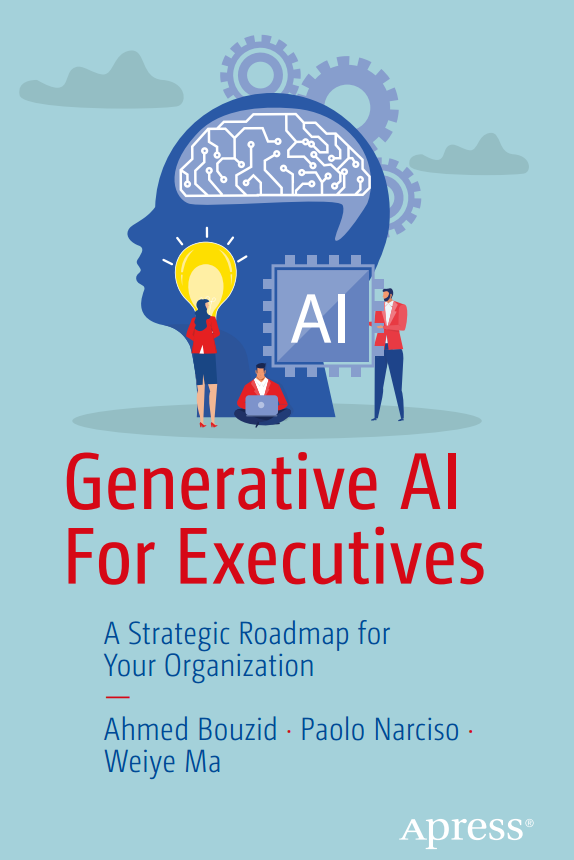
This 194-page executive playbook explains how to turn generative AI from scattered experiments into a structured business strategy.
Start by assessing your data, infrastructure, workforce skills, and organizational readiness; before investing in another platform.
Prioritize feasible, high-impact use cases, launch them in phases, and define owners, milestones, and measurable KPIs from day one.
Build governance, human judgment, training, and continuous evaluation into every deployment; the organizations doing this well are already moving from pilots toward measurable enterprise value.
TL;DR: Save this guide before your next AI strategy meeting—it could help you avoid months of expensive experimentation and build an AI roadmap that actually delivers results.
Upgrade to Digital Storm Premium for a deep dive into this Book. No time to read? Then listen our Podcast while you are driving or in the Gym, powered by Wondercraft.
Try Premium free for 7 days + get 20% off your gateway to insider AI insights, audio editions, and expert analysis.
🔗 Subscribe now to Digital Storm Premium
AI Meme of the week
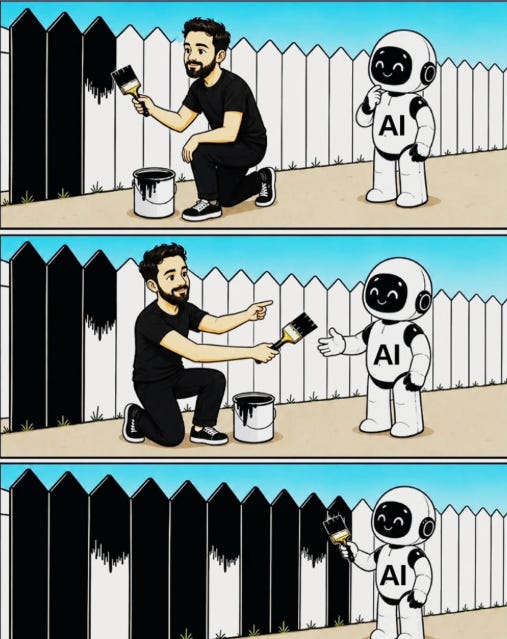
AI or not???
This was the last quiz. 67% answered “AI” - wrong!
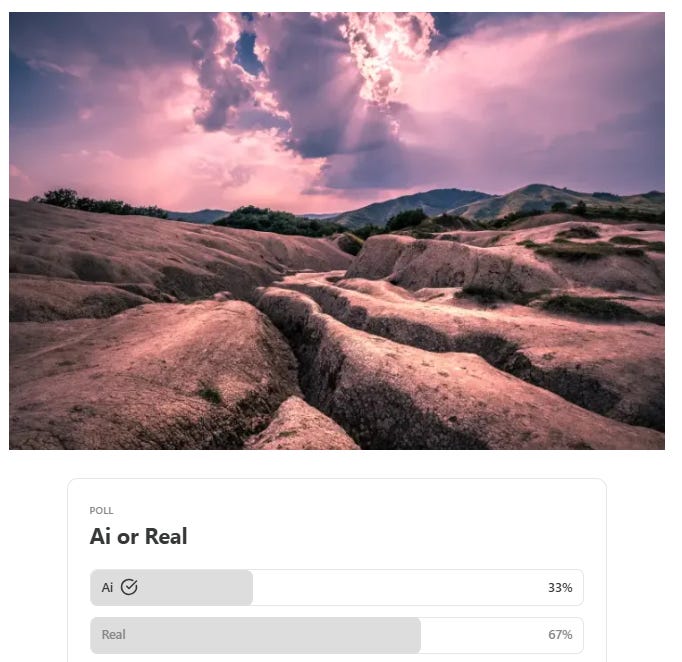
Can you answer this one?

To my dear Linkedin Readers: Sorry this only works on the Substack Newsletter - Subscribe here - it’s also free, but much better
💡 Enjoyed this edition? Share it with your network. Your support helps us keep this newsletter free and growing.
- Share - Share - Share - Share - Share - Share - Share - Share - Share - Share - Share -
We’d love to hear from you!
How did you like todays brief? Your feedback helps us improve and deliver the best possible content.
Tell us areas for improvement please - We appreciate your feedback. Thanks alot!
To my dear Linkedin Readers: Sorry this only works on the Substack Newsletter - Subscribe here - it’s also free, but much better
Knowledge Base
New cheatsheets uploaded - check them out:
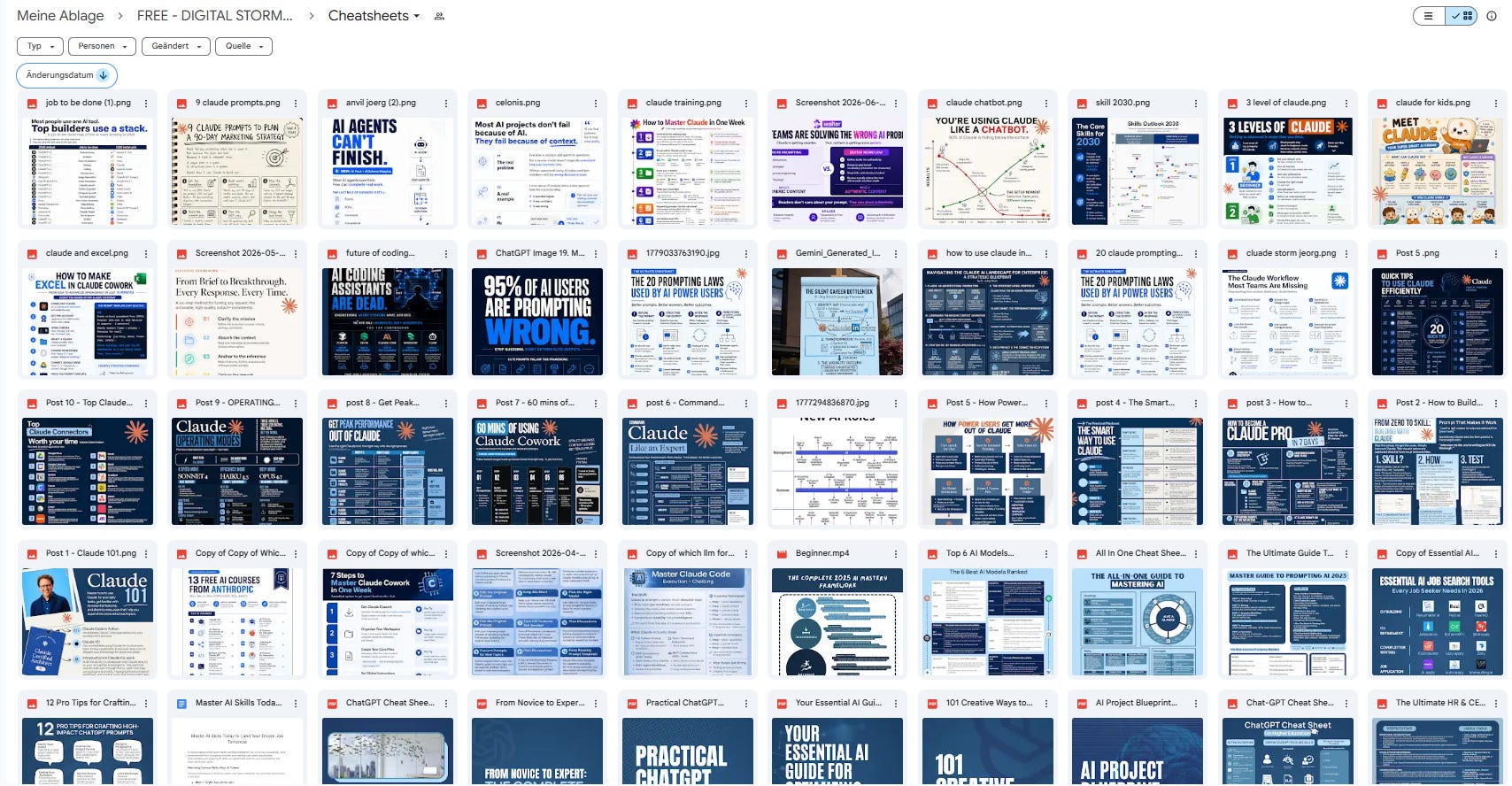
Got questions? My AI has answers. Ask anything to my 24/7 digital brain trained on this newsletter & all our Linkedin posts
Welcome Package for Subscribers (50,000+ ChatGPT Prompts, 9,000+ Free AI Tools, 1,000+ Picture generator prompts, Growth hacks for Startups & SaaS etc. etc. ➡️ »»»click here«««
Find 100+ AI eBooks, cheatsheet, prompt guides »»»click here«««
Full Access to existing eBooks, Cheatsheets, Prompt guides,… »»» click here «««
Partner with “Digital Storm Weekly”
Reach 1.5M+ decision-makers. Drive growth. Build trust.
Join leading companies like NVIDIA, AWS, Alibaba, HubSpot, Redhat, Huawei, EY and alot others who trust Digital Storm Weekly to showcase their products to an engaged, tech-savvy audience.
600,000+ newsletter readers
1.5M+ LinkedIn followers (including execs from top startups & Fortune 500s)
Newsletter published on Substack & LinkedIn (Dr. Storm & Paul Storm & Lucas Storm )
How we help:
Brand Campaigns: We promote your product through high-impact campaigns across our newsletter and LinkedIn, reaching senior decision-makers at scale.
AI & Strategy Consulting: We help SMEs, and enterprises turn AI into business results; from ideation and use-case definition to real implementation across workflows, products, and teams.
LinkedIn Growth on Autopilot: We run your LinkedIn end-to-end: strategy, positioning, content, design, and posting; helping you grow followers, attract customers, and build a credible personal or company brand without daily effort.
📩 Let’s collaborate: Email: digitalstormweekly@gmail.com
We read your emails, comments daily. Hit reply and let us know what you want more / less of! - Email: digitalstormweekly@gmail.com
Joerg (Follow: Linkedin) & Paul (Follow: Linkedin)
Have you missed any past newsletter? Check them out here:
Digital Storm, Europe’s executive influence platform.
Independent commentary. Not affiliated with or endorsed by Anthropic. Prices, availability and model behavior verified against sources on the publication date and may change. Nothing here is legal or financial advice. The signal, not the noise.
We take the responsibility of emailing you seriously. If you don’t want to receive this newsletter anymore, you can unsubscribe at any time.