

Stop Using Claude Like This. #171
One routing mistake can turn powerful agents into runaway AI spend
We are honored to count you among the >600.000 readers of “DIGITAL STORM weekly” across platforms. Please help grow our community by inviting your friends.

Most People Use 5% of Claude. Master the Rest in One Weekend

You’ve probably seen this in your headlines over the past few days: the US government has forced Anthropic to pull its two most powerful models, Mythos and Fable, offline. But do you know why?
Because these models became so powerful that the US government deemed them a national security risk. But here’s what people are gatekeeping from you: not using Claude to its full potential is a threat to your job security.
Claude ships new features almost every week:Skills, Connectors, Cowork, Vibe coding
So we found the perfect workshop for you, completely free, that condenses 800+ hours of research and real-world practice into a focused 16-hour curriculum. Introducing the 2-Day Claude AI Mastery Workshop: a live, end-to-end deep dive into Claude plus 10+ AI tools, LLMs and workflows.
It would be silly not to SIGN UP - 🧠 Sat & Sun - 🕜 10 AM – 7 PM EST
Register NOW!
Keep this free
This briefing grows by being shared
No paywall on the signal. The free edition stays free for everyone as long as readers pass it on. If one person on your team is doing real work in a personal AI account, this is the issue to forward. That is the whole growth engine, and it is you.
AWS CTO in our Podcast
Most AI projects don’t fail because the AI is bad. They fail because leaders keep managing their business the same way.
This week on Digital Storm Weekly, I sat down with Ishit Vachhrajani, one of AWS’s top global AI executives, for a conversation every executive should hear before investing another dollar in AI.
Why 95% of AI projects never scale and the mistake almost every company makes.
Why AI is a leadership problem, not a technology problem.
Why Agentic AI will force companies to rethink workflows, governance, and decision-making; not just deploy better models.
What the organizations succeeding with AI are doing differently today.
TL;DR: If you want to understand how the world’s largest enterprises are actually scaling AI, not the hype, but the reality; this is one episode you don’t want to miss. 🎧 Watch and listen: 🔗 YouTube – Amazon Music – Apple Podcasts – Spotify – RSS
The Big Shift This Week
Frontier Intelligence Goes on the Meter
On July 12, Claude Fable 5 leaves flat rate subscriptions and switches to pay per token. The real lesson is not the price. It is knowing which model to point at which job.
This weekend a quiet change lands on millions of Claude accounts. The most capable model Anthropic has ever released to the public, Claude Fable 5, comes off flat rate plans and moves to metered billing. From July 19 you pay for it by the token.
If that sounds like a reason to panic, it is not. It is a reason to get precise. The teams that will feel this change as a shock are the ones treating every prompt the same. The teams that will barely notice are the ones who already match the model to the task.
By the end of this issue you will understand the four tiers of Claude and why the smartest one costs the most, you will see exactly why a long conversation quietly gets expensive, and you will have a simple routing habit plus two ready prompts that keep your results high and your bill low.
The Shift
What actually changes on July 19
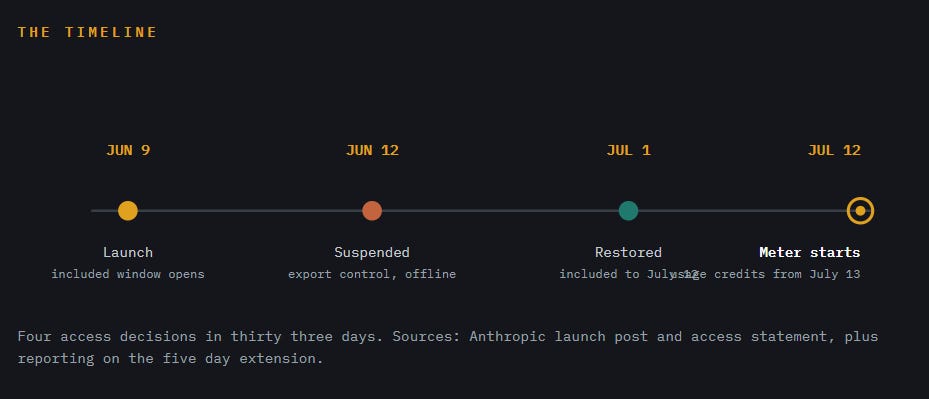
Claude Fable 5 launched on June 9 as a Mythos class model, a new tier that sits above Opus. For a short window it was included on paid plans. Then it vanished entirely for almost three weeks under a United States export control order, and returned on July 1. Since the return, paid plans have included Fable 5 for up to half of your weekly usage. That included window was going to close on July 7. After a wave of user frustration, Anthropic pushed it to July 19.
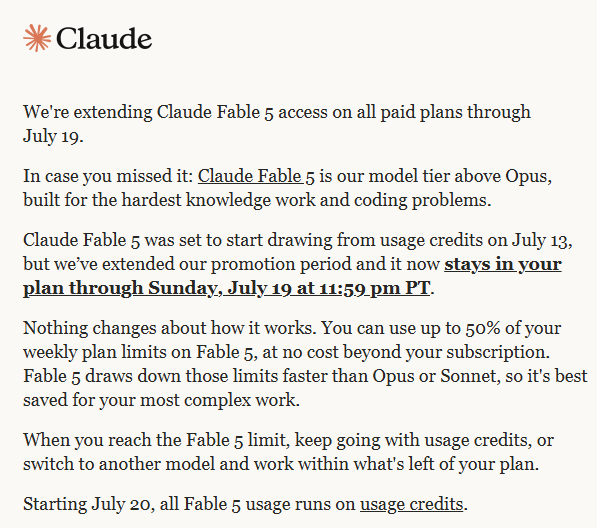
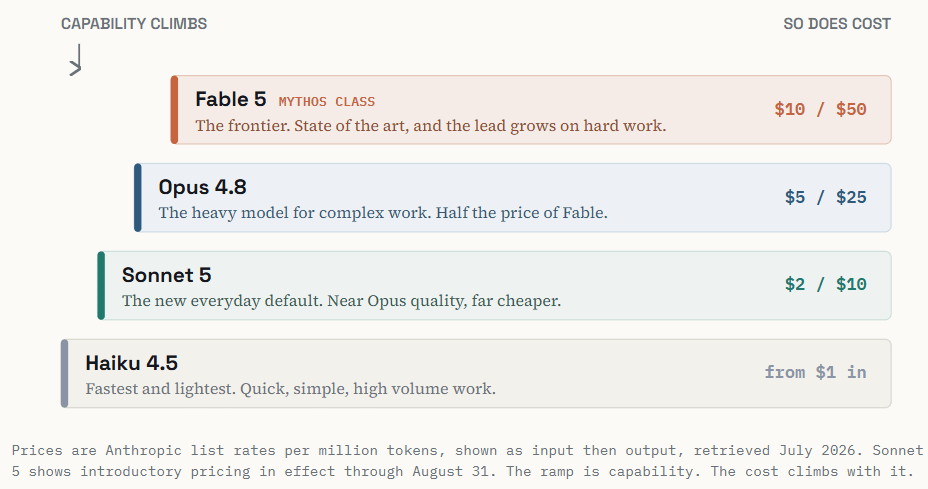
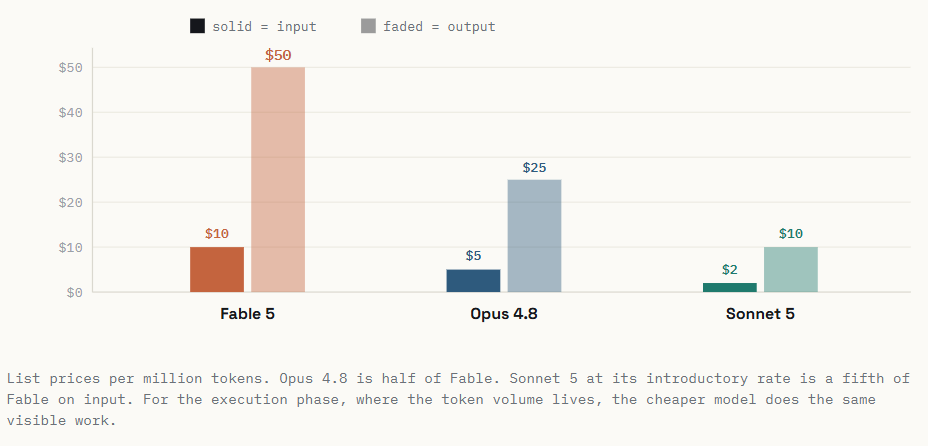
From July 19, Fable 5 no longer draws from your normal plan limits. To keep using it you enable usage credits, a metered balance billed at the same rates developers pay through the platform. The published rate is 10 dollars per million input tokens and 50 dollars per million output tokens. That is exactly double Claude Opus 4.8. If you do not enable credits, Fable 5 access simply stops. Your plan still covers Opus 4.8, Sonnet 5, and Haiku 4.5 at their normal limits, so everything else keeps working.
Anthropic has said the change is temporary and driven by compute capacity, and that it aims to bring Fable back into standard subscriptions as capacity allows. No date is attached to that promise.
Why it matters
For most people this is one new line on a bill. For anyone running long automated sessions, it is the difference between a few dollars and a few hundred. Fable 5 was built to work for hours on hard problems, which is exactly the usage that runs the meter fastest.
The Teaching Chapter
Four flavors of Claude, and why the smartest one is the most expensive
Think of Claude not as one product but as a small team with four levels of seniority. Each level trades speed and cost against raw capability. Understanding this ladder is the whole game, because almost every dollar you save comes from choosing the right rung.
The analogy that makes it click
Picture a consulting firm. A principal with twenty years of judgment costs many times what a junior analyst costs per hour. You do not hand the principal your routine formatting. You bring the principal the one hard question where judgment changes the outcome, let them set the strategy, then let the analyst carry it out. Fable 5 is the principal. Sonnet 5 and Opus 4.8 are the seniors and analysts who execute the plan well and cost far less.
How token pricing actually works
Two numbers drive every bill. Input tokens are everything the model reads: your message, your files, and the entire conversation so far. Output tokens are everything the model writes. Fable charges 10 dollars per million read and 50 dollars per million written. Roughly, a token is about three quarters of a word, and the newest Claude models use a tokenizer that produces about 30 percent more tokens for the same text. So a page of writing is more tokens than you might guess.
Here is a worked example you can trust, because you can check the arithmetic yourself. One planning pass that reads 200,000 tokens of context and writes 40,000 tokens of output costs, on Fable 5, 0.2 times 10 dollars plus 0.04 times 50 dollars, which is 4 dollars. The identical work on Sonnet 5 at its introductory rate costs 0.2 times 2 dollars plus 0.04 times 10 dollars, which is 80 cents. Same tokens. Five times the cost on the frontier model.
The part that surprises everyone
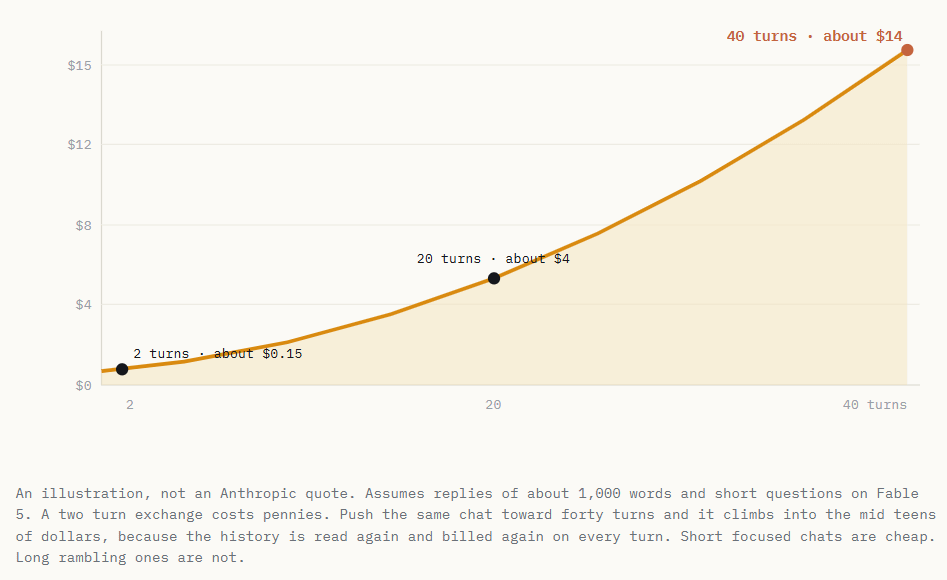
There is one mechanic that catches almost every user. The model has no memory between turns. So on every single turn, the entire conversation so far is sent back in as input and charged again. Turn one is cheap. By turn twenty, each new question drags twenty turns of history behind it. The input you pay for grows with every exchange, which is why cost does not rise in a straight line. It curves upward.
Explain it simply
Every message you send to Fable also resends the whole conversation for it to read again. More turns means the whole conversation is read again, which means more cost. A fresh chat for a fresh task is not just tidy. It is cheaper.
What Premium readers get this week
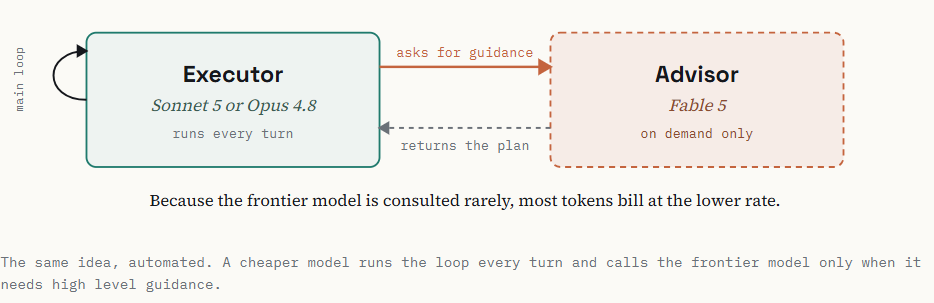
The premium edition turns this lesson into a system. It includes the full model routing decision tree as a printable page, a scoring rubric for deciding when a frontier model is actually worth double, the effective cost math once caching and batch discounts are applied, the advisor and executor architecture in full, and a team cost governance checklist for setting spend caps before anyone runs an agent. The free edition teaches the habit. Premium gives you the operating manual.
The Routing Rule
Use the principal for the plan, the analyst for the work
The single most valuable habit is to stop treating Fable 5 as your default and start treating it as a specialist you call in for the hardest part of a job. Point Fable at the planning or the one hard reasoning pass. Get the strategy, the structure, the decision. Then switch the model to Sonnet 5 or Opus 4.8 and let it execute across all the follow up turns, where most of your tokens are actually spent.
Common mistake
Running Fable 5 as your daily driver for routine work is like paying a principal to reformat slides. It is the fastest route to a bill that surprises you. Save the frontier model for frontier problems.
How To Talk To It
Give it goals, not tasks
Older models lost the thread after a few steps, so we all learned to chop work into tiny instructions. Rewrite this. Summarize that. Make it shorter. Fable 5 is built for the opposite. It plans, asks clarifying questions before it starts, works for a long time without drifting, pushes back, and checks its own work before handing it over. Feeding it one line tasks wastes most of what you are paying for.
The shift is from tasks to goals. A task says: write a follow up email to this client. A goal says: this client owes two invoices and went quiet three weeks ago, here is the full thread, the outcome I want is payment without damaging the relationship, plan your approach, draft what is needed, and ask me what you do not know.
Four instructions make almost any goal prompt sharper. In Anthropic’s own testing, the evidence rule alone nearly eliminated inflated reports that a job was finished when it was not.
Lead with the answer. Ask for the bottom line in the first sentence, then the detail. No hunting through method to find the result.
Demand evidence. Tell it to report only what it can point to, and to flag anything unverified rather than quietly asserting it.
Separate advising from acting. Say which you want. Thinking out loud, write nothing yet. Or, handle this end to end and only check in if something is irreversible.
Cut the overthinking. When it has enough to act, tell it to give a recommendation, not a menu of options.
Mega Prompt of the Week
The decision stress test
This is a frontier worthy use of Fable 5. It holds your stated priorities, runs best, base, and worst cases, and argues against its own recommendation. Paste it into a Fable 5 chat, answer its questions, then switch to Opus 4.8 to work through the output.
paste into a Fable 5 chat
I am about to make a significant decision and I want it stress tested before I commit, because reversing it later will be costly. Treat this like the review a sharp board member would run, not a summary of considerations.
First, ask me for the decision and the options on the table, my priorities ranked in order, the constraints I cannot change, and the deadline. Then interview me, a few questions at a time, until you understand the decision better than I have stated it. Push on anything I am vague about, because vagueness is usually where the risk hides.
Once you have enough, give your verdict. Open with your recommendation in one sentence. Then show how each option scores against my ranked priorities, the best case, base case, and worst case for the option you recommend, the strongest argument for the option you rejected, and the single most likely way your recommendation turns out to be wrong. Be direct. Do not hedge with it depends, because I will have told you what I value. If my priorities contradict each other, name the contradiction rather than working around it. Before you finish, check your reasoning against my stated priorities and fix anything that drifted.
Why it works
It forces ranked tradeoffs, scenario thinking, and a genuine self critique, which is exactly the multi step reasoning the frontier model is good at. It also refuses to let the model flatten into it depends, the failure mode of weaker models.
Image Prompt of the Week
Frontier on the meter
A production ready prompt for any leading image model.

image prompt
A minimalist editorial illustration of a single glowing amber usage meter mounted on a dark instrument panel, the needle pinned near maximum, thin precise linework, warm amber and deep charcoal palette, soft studio lighting, isometric perspective, generous negative space, no text, no logos, aspect ratio 16 by 9.
What Most People Missed
The two discounts that quietly cut the bill
Buried in the same pricing that makes Fable expensive are two levers most people never touch. Reading the same context repeatedly, such as a long document you keep asking about, can use prompt caching, which drops cached input to about a tenth of the normal rate. And work that does not need an instant answer can run through batch processing at half price. For repeated, high context work, these two together can change the economics more than switching models does.
AI Term in 60 Seconds
Usage credits
A usage credit balance is simply metered billing sitting on top of your subscription. Instead of a request counting against a flat weekly allowance, it draws real money from a prepaid balance, priced per token. You top it up, you can set an auto reload, and there is a daily ceiling. The point to remember: with credits on, an automated agent can spend real money while you are not watching, so set a cap first.
Monday Morning Action
Two things to do in under thirty minutes
One. Before July 13, open Settings, then Usage, and set a monthly spend cap you are comfortable with. If you manage a team, set per person limits too. This one setting is the difference between a predictable bill and a nasty surprise.
Two. Run a single hard planning pass on Fable 5 this week while it is still included, capture the plan, then switch the model to Opus 4.8 and let it do the rest. Feel the difference in your own work before the meter starts.
Test Yourself
Test yourself: Three questions
Why does a forty turn conversation cost so much more than two short ones, even when each message is small?
You need to migrate a large codebase and also reformat a hundred routine documents. Which task deserves Fable 5, and which should go to a cheaper model?
What single setting should you change before letting an automated agent run on usage credits?
Answers at the foot of the issue.
AI tutorial: build your routing policy in 30 minutes
Objective
Create a simple personal or team rule for choosing fast, workhorse, or expert AI.
Step 1 List 20 recent AI tasks
Use your chat history, browser history, or memory. Write the task and the outcome, not the prompt. “Prepared a supplier comparison” is better than “asked five questions.”
Step 2 Score two dimensions
For each task, score:
· Ambiguity: 1 = rules are clear; 5 = the problem is poorly defined.
· Consequence: 1 = easy to reverse; 5 = a wrong answer creates material damage.
Step 3 Route the task
· Scores 1–2 on both dimensions: fast lane.
· High ambiguity but low consequence: workhorse lane.
· Low ambiguity but high consequence: workhorse plus human or expert review.
· High on both: expert lane, then route execution back down.
Step 4 Define an escalation trigger
Examples:
· Sources disagree on a load-bearing fact.
· The model fails the same acceptance test twice.
· The decision is difficult to reverse.
· Regulated or confidential data changes the risk.
· A human reviewer cannot explain why the recommendation is correct.
Step 5 Test one workflow twice
Run the same task with your workhorse and expert model. Use the same files, success criteria, and maximum output length. Compare:
· Was the outcome accepted on the first pass?
· How much review time was required?
· Did the expert model discover a material issue?
· Was the improvement worth the extra cost or latency?
Quality-control checklist
· The task has a named outcome.
· The acceptance test is written before the model runs.
· Sensitive data is handled under approved policy.
· The thread contains only relevant context.
· The selected model is recorded.
· Review time and rework are counted.
Upgrade
Go from the habit to the operating system
This free edition gave you the routing habit, the cost mechanics, and two prompts. The premium edition this week turns that into a system you can run across a team. You get the full model routing decision tree, a scoring rubric for when the frontier model earns its double price, the effective cost math after caching and batch discounts, the advisor and executor architecture in full, a cost governance checklist for spend caps and per seat limits, an executive prompt for designing your own model routing policy, a risk and tradeoff analysis, and a 7, 30, and 90 day rollout plan. If you make model choices for more than yourself, that is the difference between hoping the bill behaves and knowing it will.
One upgrade pays for itself the first time the effort mapping saves you a model bill.
Still not sure? In the premium edition you will get access to 15+ AI deals worth $1,000+ in savings. It’s a mix of $50 credits, 10–20% discounts, and a few tools that are free to start; small wins that stack up fast.
Here some examples:
getviktor ($50 off first purchase), testimonial (15% off for 12 months), firecrawl (10% off first purchase), intellijend (10% off lifetime), Cal.com (20% off for 12 months), chroniclehq (100% off first purchase), marblism (10% off lifetime), Dub (20% off for 3 months), Guideless (20% off for 3 months), Granola (100% off first month), Hundred Health (10% off for 6 months), anything (20% off first purchase), littlebird ($20 off first purchase), Supercut.ai (10% off for 12 months), and kite (10% off for 12 months).
Pass It On - Keep this free and independent.
Know someone on your team who still opens the most powerful model for every tiny task? That habit is about to have a price. Forward this issue and save them the surprise. The best place to send it is your team channel, where one link spares everyone the same mistake.
Test yourself · answers
Because the model has no memory between turns, the entire conversation is read again and billed again as input on every turn. History accumulates, so the cost curves upward rather than rising in a straight line.
The codebase migration is a genuine frontier task and deserves Fable 5. The routine document formatting is high volume, low judgment work and belongs on a cheaper model such as Sonnet 5.
Set a spend cap in Settings, then Usage, before you enable or run anything on credits.
Sources
Anthropic, Claude Fable 5 and Claude Mythos 5 (launch): anthropic.com/news/claude-fable-5-mythos-5
Anthropic, access statement: anthropic.com/news/fable-mythos-access
Claude Platform Docs, Introducing Claude Fable 5 and Claude Mythos 5: platform.claude.com/docs
Claude Platform Docs, Pricing: platform.claude.com/docs/en/about-claude/pricing
ReportingForbes, on the five day extension to July 12: forbes.com
Event: What if your next breakthrough in B2B communication happens in Würzburg, Germany?
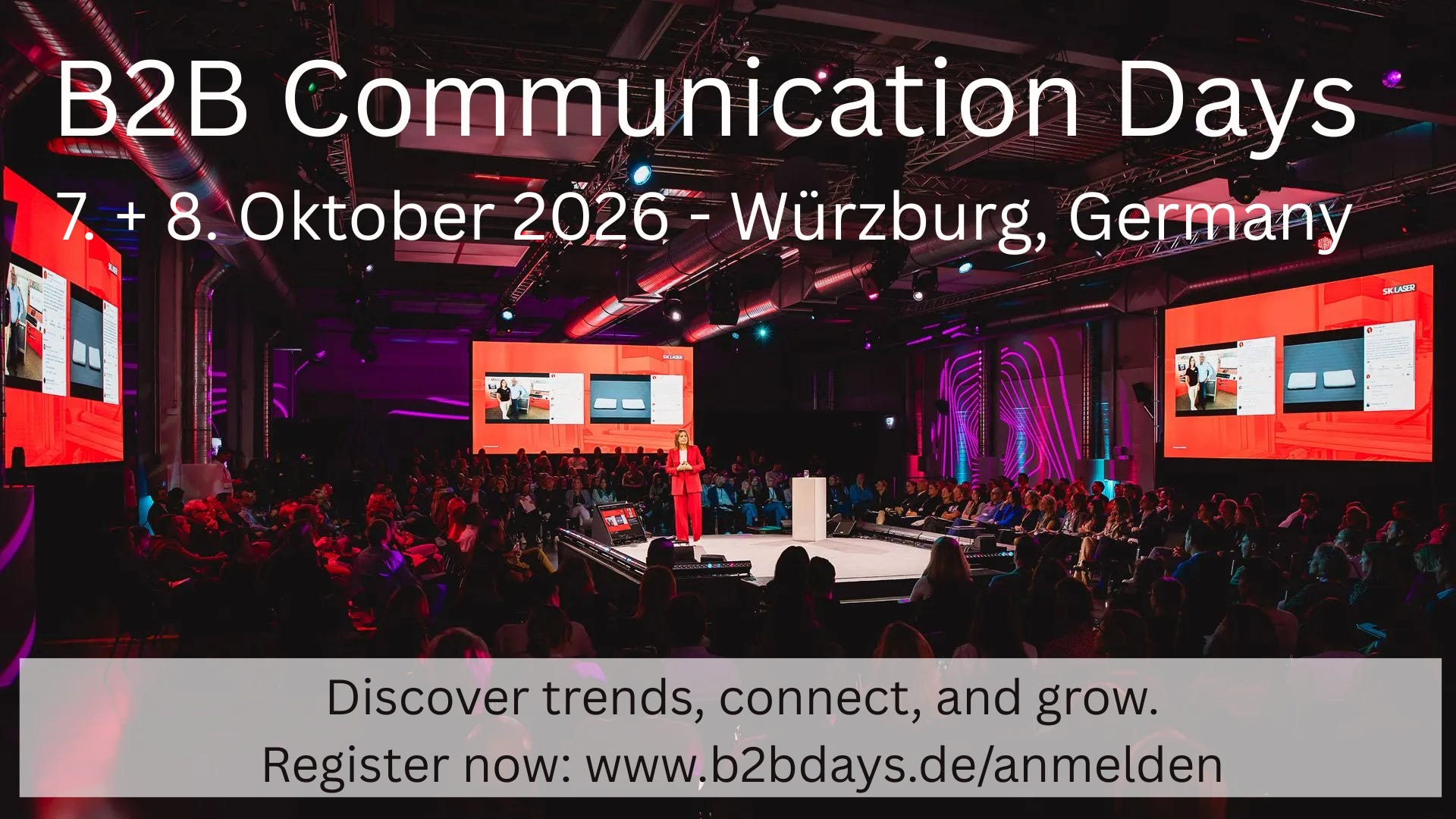
50+ speakers from marketing, communications, technology, science, and industry.
Three stages packed with keynotes, real-world use cases, practical tools, and MarTech insights.
Around 700 B2B professionals coming together to exchange ideas, build relationships, and shape what comes next.
I’ll be there too; join me on 7–8 October 2026 for two focused days of learning, inspiration, and high-value networking. with my Code B2B26_STORM20 you get 20% off
TL;DR: Don’t just follow the future of B2B communication—help create it; secure your ticket now - Important: 20% off with this code: B2B26_STORM20
🔥AI Express 🔥
To my Linkedin Readers: Sorry this only works on the Substack Newsletter - Subscribe here - it’s also free, but much better
Video of the Week
Anthropic CEO Dario Amodei on the Future of AI — Bloomberg
Why it is worth watching: the conversation places model capability inside a larger economic and governance debate. Listen for the tension between rapid capability growth, infrastructure requirements, safety controls, and the speed at which organizations can adapt.
Five viewing questions:
1. Which claims depend on technical progress continuing at the recent rate?
2. Where does the speaker distinguish capability from deployment?
3. Which risks require product controls, and which require policy?
4. How could higher model intelligence alter organizational design?
5. What would falsify the most consequential forecast?
Practical takeaway: do not translate a frontier-model launch directly into a company-wide default. Translate it into testable use cases, operating controls, and evidence. Watch on YouTube
Whitepaper of the Week
58% of companies have an AI strategy.
Only 44% can actually execute it.
The real AI race is no longer about adoption—it’s about turning strategy into measurable business value
79% of AI initiatives fail at or after the pilot stage.
AI is creating efficiency before revenue—84% report operational gains vs. 75% revenue impact.
The biggest blockers aren’t AI models—they’re integration complexity, data quality, and operating models.
TL;DR: The winners of 2026 won’t have the best AI tools—they’ll have the best AI execution. If you’re serious about enterprise AI, this report is one of the most data-driven reads you’ll see this year
👉 Upgrade to Digital Storm Premium for a deep dive into this. No time to read? Then listen our Podcast while you are driving or in the Gym, powered by Wondercraft.
Try Premium free for 7 days + get 20% off your gateway to insider AI insights, audio editions, and expert analysis.
🔗 Subscribe now to Digital Storm Premium
Trending Tools
Claude Fable 5
Use it for: difficult planning, long-horizon agents, adjudicating conflicting evidence.Best user: researchers, advanced operators, agent builders.
Watch: usage credits, long-context cost, and whether your task truly needs the top tier.
GPT-5.6
Use it for: routed professional work across three model sizes; complex work can use higher reasoning or multi-agent modes.
Best user: teams that want one family spanning daily and frontier tasks.
ChatGPT Work
Use it for: multi-step assignments across apps, files, and connected systems.
Best user: professionals delegating outcomes rather than requesting isolated answers.
Muse Spark 1.1
Use it for: computer use, coding, multimodal agent workflows, and long sessions.
Best user: developers building agents around a large managed context.
Muse Image
Use it for: reference-aware image generation and precise editing.
Best user: brand, design, and content teams.
The remaining find in Premium Version
My personal Favourites:
Create a studio-quality podcast or audiobook in minutes with Wondercraft AI and hear it in action on the new Digital Storm Premium Podcast, upgrade here:
Bloome - a collaborative workspace where humans and multiple AI agents share context, challenge ideas, and complete projects together.
Abacus LLM - cancel your 20 $ ChatGPT subscription and use this all in one tool
Headlines you should know
OpenAI launched GPT-5.6 as Sol, Terra, and Luna. The family approach makes cost, speed, and capability an explicit routing choice rather than a hidden product decision. Official announcement
ChatGPT Work was introduced for longer, multi-step assignments. The product can act across connected files and apps, making process design more important than isolated prompting. Official announcement
GPT-5.6 became the preferred model in Microsoft 365 Copilot. Frontier capability is moving directly into Word, Excel, PowerPoint, Chat, and Cowork. Official announcement
Meta released Muse Spark 1.1. Meta emphasizes long-running agentic work, computer use, coding, and active management of a one-million-token context window. Official announcement
Meta introduced Muse Image and Muse Video. The focus is instruction-following, editing, reference composition, visual fidelity, and native audio. Meta AI news
SpaceXAI launched Grok 4.5. The model is positioned for coding, knowledge work, and office-document creation, with published API pricing of $2 input and $6 output per million tokens. Official announcement
Mistral added version control for prompts and skills in Studio. This treats instructions as governed production assets with ownership and traceability. Official announcement
Mistral released Robostral Navigate. The 8B model is designed for embodied navigation using a single RGB camera. Official announcement
Google made AlphaEvolve generally available on Google Cloud. The system uses AI to evolve algorithms for difficult optimization and scientific problems. Official announcement
Three additional FireSat satellites launched. Google says the network uses AI and purpose-built sensors to help detect small wildfires earlier. Official announcement
The Government of Alberta described using Claude for cybersecurity review. The case shows agents moving from general productivity into controlled defensive operations. Anthropic case study
UST announced a physical-AI collaboration with Anthropic. The company plans to train 20,000 engineers, architects, and consultants on Claude. Official announcement
OpenAI expanded its bio bug bounty. The ongoing private program will test frontier models for universal jailbreaks against biosafety protections. Official announcement
OpenAI audited SWE-Bench Pro and estimated that roughly 30% of tasks are broken. The larger lesson: model evaluations need evaluation too. Research note
Deutsche Telekom published an enterprise adoption case with OpenAI. The case reports more than 50,000 monthly active users and reinforces that operating-model change matters alongside model capability. Case study
AI Meme of the week

AI or not???
This was the last quiz. 67% answered “AI” - wrong!
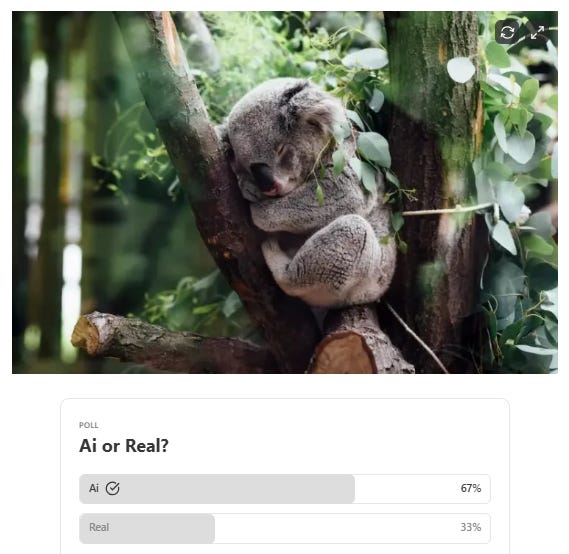
Can you answer this one?

To my dear Linkedin Readers: Sorry this only works on the Substack Newsletter - Subscribe here - it’s also free, but much better
💡 Enjoyed this edition? Share it with your network. Your support helps us keep this newsletter free and growing.
- Share - Share - Share - Share - Share - Share - Share - Share - Share - Share - Share -
We’d love to hear from you!
How did you like todays brief? Your feedback helps us improve and deliver the best possible content.
Tell us areas for improvement please - We appreciate your feedback. Thanks alot!
To my dear Linkedin Readers: Sorry this only works on the Substack Newsletter - Subscribe here - it’s also free, but much better
Knowledge Base
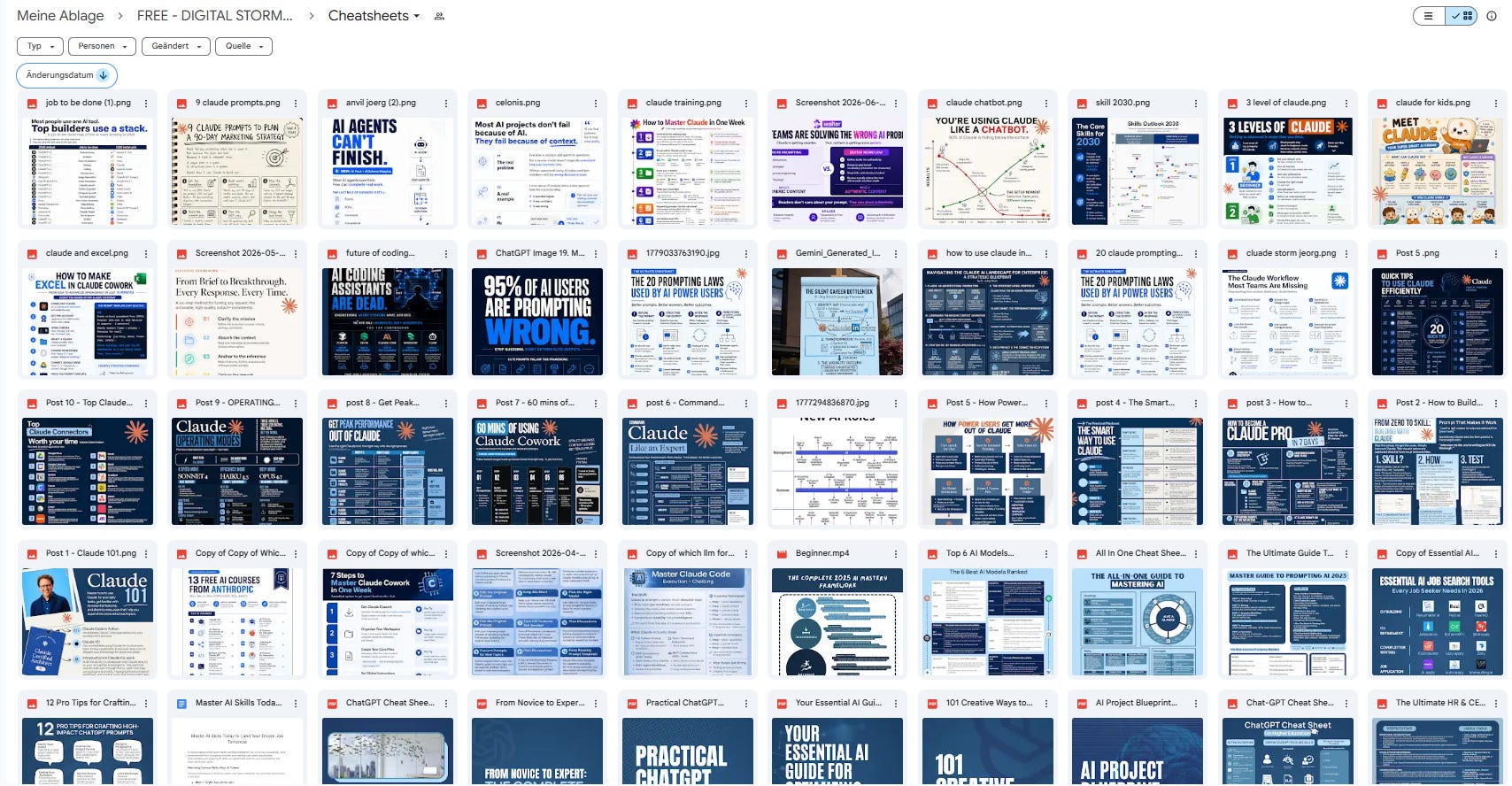
New cheatsheets uploaded - check them out:
Got questions? My AI has answers. Ask anything to my 24/7 digital brain trained on this newsletter & all our Linkedin posts
Welcome Package for Subscribers (50,000+ ChatGPT Prompts, 9,000+ Free AI Tools, 1,000+ Picture generator prompts, Growth hacks for Startups & SaaS etc. etc. ➡️ »»»click here«««
Find 100+ AI eBooks, cheatsheet, prompt guides »»»click here«««
Full Access to existing eBooks, Cheatsheets, Prompt guides,… »»» click here «««
Partner with “Digital Storm Weekly”
Reach 1.5M+ decision-makers. Drive growth. Build trust.
Join leading companies like NVIDIA, AWS, Alibaba, HubSpot, Redhat, Huawei, EY and alot others who trust Digital Storm Weekly to showcase their products to an engaged, tech-savvy audience.
600,000+ newsletter readers
1.5M+ LinkedIn followers (including execs from top startups & Fortune 500s)
Newsletter published on Substack & LinkedIn (Dr. Storm & Paul Storm & Lucas Storm )
How we help:
Brand Campaigns: We promote your product through high-impact campaigns across our newsletter and LinkedIn, reaching senior decision-makers at scale.
AI & Strategy Consulting: We help SMEs, and enterprises turn AI into business results; from ideation and use-case definition to real implementation across workflows, products, and teams.
LinkedIn Growth on Autopilot: We run your LinkedIn end-to-end: strategy, positioning, content, design, and posting; helping you grow followers, attract customers, and build a credible personal or company brand without daily effort.
📩 Let’s collaborate: Email: digitalstormweekly@gmail.com
We read your emails, comments daily. Hit reply and let us know what you want more / less of! - Email: digitalstormweekly@gmail.com
Joerg (Follow: Linkedin) & Paul (Follow: Linkedin)
Have you missed any past newsletter? Check them out here:
Digital Storm, Europe’s executive influence platform.
Independent commentary. Not affiliated with or endorsed by Anthropic. Prices, availability and model behavior verified against sources on the publication date and may change. Nothing here is legal or financial advice. The signal, not the noise.
We take the responsibility of emailing you seriously. If you don’t want to receive this newsletter anymore, you can unsubscribe at any time.
I’ll be at SH around 17th to 20th, for WAIC. If you’re also there, let me know.