

Stop Feeding Claude. Start Directing It #172
The two primitive setup that makes Claude Cowork sharper, faster, and far cheaper.
We are honored to count you among the >600.000 readers of “DIGITAL STORM weekly” across platforms. Please help grow our community by inviting your friends.

Two voice AI leaderboards. One winner.

Cartesia just topped both the Speech-to-Text and Text-to-Speech leaderboards from Artificial Analysis with its new Sonic-3.5 and Ink-2 models. Nobody else has managed both at once.
The secret sauce: State Space Models (SSMs), an architecture Cartesia’s been betting on for years instead of the usual transformer setup. The upshot is real-time audio and agents that don’t get slower or clunkier the longer a conversation runs.
Sonic-3.5 talks in 42 languages, and it’s not an afterthought. The pacing and emotion hold up whether it’s speaking English, Portuguese, or German.
Ink-2 listens in real time and actually knows when you’re done talking, so it stops cutting people off mid-sentence.
Teams like ServiceNow, Quora, and toby are running on Cartesia models for everything from enterprise support lines to real-time translation.
Podcast with CTO All for One Group
Think buying the best AI model will transform your business?
It probably won’t. Dr. Ulrich Faisst, CTO of All for One Group, argues that the real bottleneck isn’t the technology; it’s how your organization is designed to use it. Drawing on decades of transformation leadership across enterprise technology, he believes AI succeeds when it’s treated as a business transformation, not an IT initiative.
Stop chasing endless PoCs and start measuring business impact.
Build an AI strategy first, then choose the technology.
Data quality, governance, and leadership are bigger success factors than model selection.
Scale AI through operating models and end-to-end process transformation, not isolated pilots.
TL;DR: The companies that win with AI won’t necessarily have the smartest models—they’ll have the strongest operating model. Watch the full DIGITAL STORM weekly conversation with Dr. Ulrich Faisst if you’re serious about moving AI from experimentation to enterprise-wide value.
If you’re responsible for enterprise AI strategy, digital transformation, or technology leadership, this episode delivers practical advice grounded in real-world implementation. 🔗 YouTube – Amazon Music – Apple Podcasts – Spotify – RSS
Most people who set up Claude Cowork did this thing...
They built a folder. They wrote long files about themselves and their company. They pasted a wall of global instructions so Claude would “know everything.”
And it quietly made their results worse.
Not because the effort was lazy. Because of a mechanism almost nobody sees: Cowork does not read your context once. It re reads it on every loop, inside every one of the parallel Claude sessions it spins up to do your work. Bloated context is not a one time gift to the model. It is a tax you pay again and again, on speed, on quality, and on your token bill.
This week two things made that tax impossible to ignore. Cowork went across your devices, so it now runs long jobs in the background while your laptop is closed. And the flagship model shifted to metered credits, which turns sloppy setup into a line item you can actually see. So the setup question stopped being cosmetic. It became the difference between an agent that compounds your work and one that burns your budget.
The fix is not a bigger folder. It is a smaller, sharper architecture built from two pieces. By the end of this issue you will be able to build it, share it with a colleague, and cut what you waste every session.
What You Will Learn
Why loading Claude with heavy “about me” files and long global instructions makes its output blander, not smarter
The single test that tells you whether a task should be a Skill or a Project
How to build one reusable Skill and hand it to your whole team in under 20 minutes
Why a long chat thread silently multiplies your cost, and the three habits that stop it
The clear line between when Cowork is the right tool and when Chat or Code wins
Keep this free
This briefing grows by being shared
No paywall on the signal. The free edition stays free for everyone as long as readers pass it on. If one person on your team is doing real work in a personal AI account, this is the issue to forward. That is the whole growth engine, and it is you.
- Share - Share - Share - Share - Share - Share - Share - Share - Share - Share - Share -
The Big Shift
The agent got legs. Now setup is a money decision.
For a year the mental model of a chatbot was simple. You ask, it answers, you do the work. Cowork broke that. It is an agentic mode inside the Claude desktop app, a third tab beside Chat and Code, that reads, edits, and creates files on your machine and runs long multi step jobs on its own. You hand off a goal and it returns a finished deliverable.
In the coverage window that agent stopped being tied to one desk. Cowork sessions and files now reach you on web and mobile, so a job you start in the morning keeps running in the background and pings you only when a decision needs a human. At the same time, the opt in flagship model moved to prepaid, metered credits at roughly double the per token cost of the default. Translation: the way you set Cowork up now shows up directly in what it costs to run.
This week matters because the agent became infrastructure, and infrastructure that is configured badly gets expensive quietly. The good news is that the better setup is also the simpler one. By the end of this issue you will understand why less context beats more, and exactly what to build instead.
The Teaching Chapter
The Context Paradox, and the two pieces that solve it
Here is the trap. It feels obvious that giving an AI more about you must produce more tailored, more accurate work. So people build a home folder, fill it with a personal profile, a company profile, a writing style file, and a stack of past outputs, then point Cowork at the whole thing every session.
Three things go wrong.
How it actually works
Cowork is not one Claude. When you hand it a task, it plans, then spins up several Claude sessions in parallel that read your files, search the web, run code, and write outputs, looping until the job is done. Every loop re reads whatever context is resident. So a bloated folder is not paid for once. It is paid for on every loop, by every session, in tokens and in attention.
That is the paradox. Past a point, more context does not add intelligence. It adds noise the model has to wade through and cost you pay on repeat.
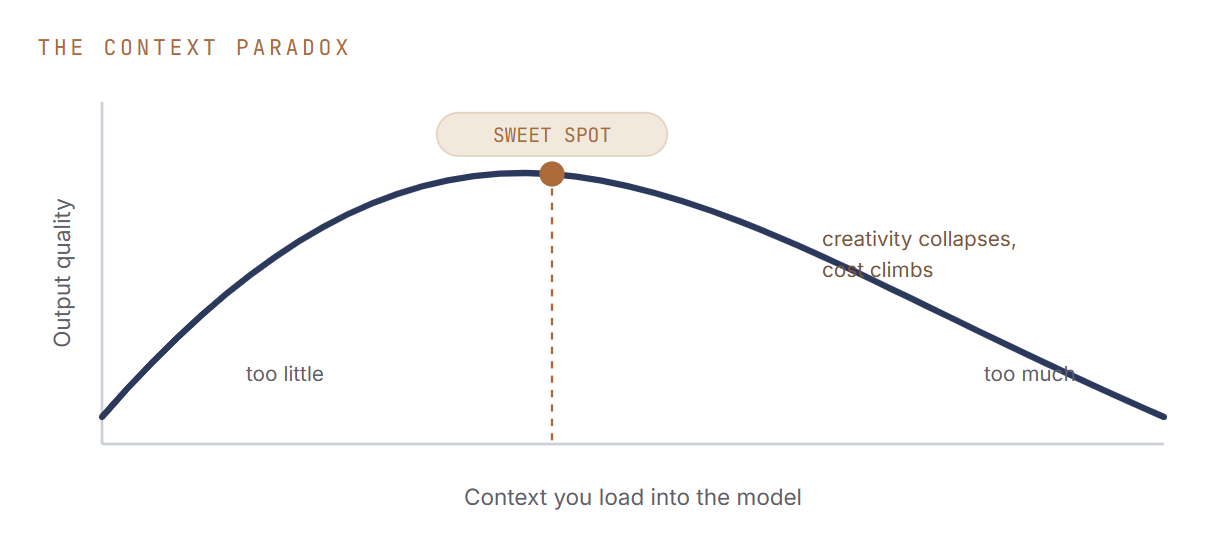
The three failures of the folder
Leakage. Even when you tell it to ignore an outputs folder, an agent that can see your files will sometimes read stale work and drag last quarter into this quarter.
Maintenance tax. You have a full time job. Nobody keeps a personal profile file current for long. It rots, and rotten context is worse than none.
Creativity collapse. Over specify the context and the model plays it safe, returning near identical answers. Fine for a repeated contract. Fatal for brainstorming.
The analogy that makes it click
Imagine hiring a brilliant contractor, then forcing them to re read your entire staff handbook before every single sentence they write for you. They will be slower, pricier, and duller. The handbook is not helping. The constant re reading is the problem. That is a folder heavy Cowork setup.
The two primitives that replace it
You only need two things. Not folders. Not walls of instruction. Two clean building blocks.
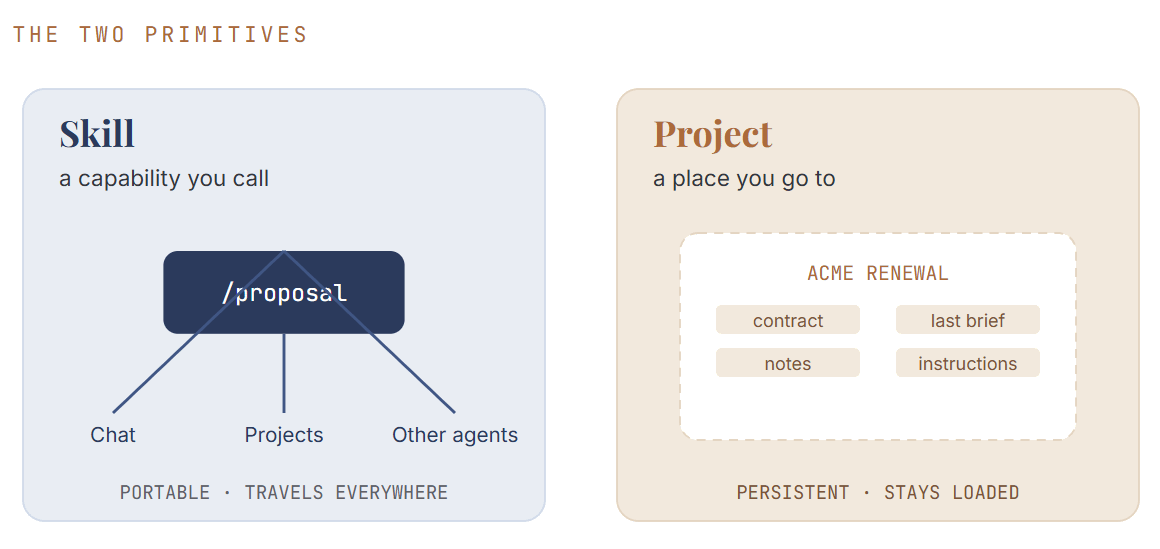
Skill · a capability you call
A Skill is a small package that encodes how to do one repeatable thing: draft a contract, write a hook, format a deck. You invoke it by name with a slash command, or let Claude load it automatically when your request matches its description. It bundles your instructions and any reference files it needs. Crucially, only its one line description sits in context until it is actually needed, then the full body loads. That is why you can keep dozens of Skills installed for almost no ongoing cost. And because Skills follow an open standard that Anthropic released at the end of 2025, the same Skill file can run in other agents too. Your know how becomes portable, not locked in.
Project · a place you go to
A Project is a persistent container. You drop in the files and instructions for one specific context, a client, a campaign, an account, and every chat inside that Project inherits them. It remembers across chats, and it does not bleed into your other Projects. Share it once with your team and you have a single collaborative space instead of everyone rebuilding context from scratch.
Worked example
The task: draft a renewal proposal for one specific client, Acme.
The folder way. One giant folder holds your profile, every client, and old outputs. Cowork reads all of it, quietly pulls in last quarter’s Acme numbers, and hands you a generic, slightly stale proposal. You spend twenty minutes correcting it, which stacks more history the model re reads on every reply.
The two primitive way. A Project named Acme Renewal holds only Acme’s contract, notes, and last campaign. A Skill named /proposal encodes your proposal structure and tone. You open the Acme project, type /proposal plus the ask. The model now has exactly the right context and exactly the right method, and nothing else to trip over. First draft lands close.
Same model. Same task. The result is better because the input was narrower, not broader.
Explain it simply
In plain language
Do not teach Claude everything about you and hope it picks the right bits. Give it one clear method (a Skill) and one clean set of facts for the job in front of it (a Project). It does better work with less, because it stops re reading things it does not need.
The part that surprises most people
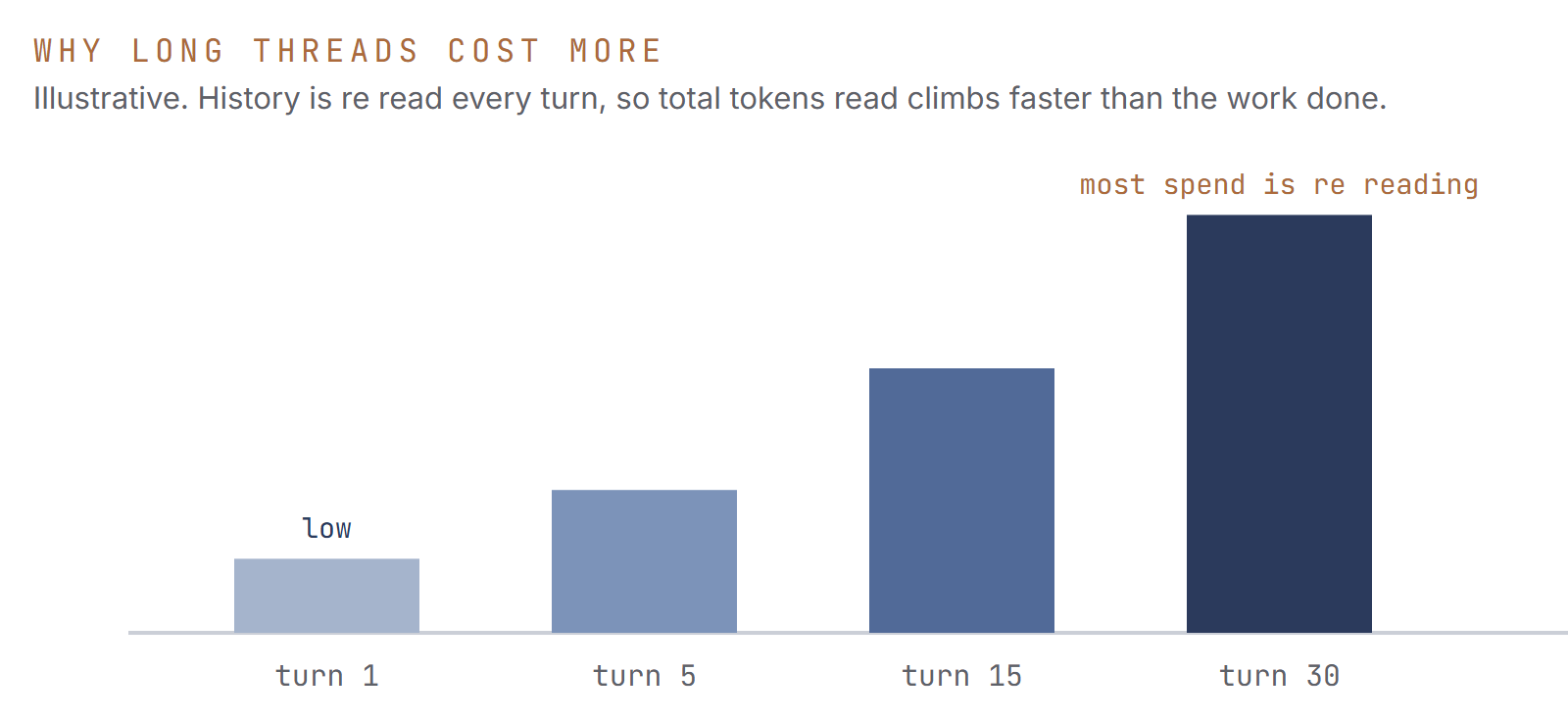
The biggest cost driver in Cowork is not which model you pick. It is how long your conversation gets. Because every turn re reads the whole thread, a long back and forth where you keep saying “no, I meant this” can spend most of its tokens re reading history rather than producing anything new. The instinct to send one more correcting message is the expensive instinct.
Common mistake
Turning everything into one type. People either make forty Skills that should have been three Projects, or forty near identical Projects that should have been one shared Skill. Both create the exact clutter you were trying to escape. The cure is a single shared test, below.

What most people miss
Session hygiene beats prompt cleverness. Three habits recover more speed and budget than any wording trick: edit or restart from a higher point instead of stacking corrections, summarize and open a fresh session when a thread gets long, and batch related asks into one message instead of three. Then match the model to the job. Keep light work on a smaller, faster model, save the default agent model for real tasks, and treat the metered flagship as a scalpel you reach for on the hardest jobs, not a default you leave running.
What to remember
Cowork re reads your context on every loop, so less, sharper context wins.
Two primitives replace the folder: Skills for methods, Projects for context.
Your longest cost lever is conversation length, not model choice.
Try Premium free for 7 days + get 20% off your gateway to insider AI insights, audio editions, and expert analysis. Subscribe now to Digital Storm Premium
Mega Prompt of the Week
The Skill Architect
Copy this into a Cowork session. Instead of guessing at a Skill, it interviews you first, then writes a clean, valid Skill you can save and invoke by name. It is the fastest honest way to turn something you already do well into something your team can call.
# ROLE
You are a Skill Architect for Claude Cowork. Your job is to turn one
repeatable task the user already performs into a single, clean,
installable Skill.
# OBJECTIVE
Produce one valid SKILL.md: YAML frontmatter with a name and a precise
description, followed by a clear instruction body Claude can follow
every time the Skill is invoked.
# PROCESS
1. Before writing anything, interview me one question at a time using
the ask questions pattern. Ask only what you actually need:
what the task is, what a great output looks like, the inputs it
needs from me, the steps I follow, my tone or format rules, and
the mistakes to avoid.
2. Do not ask a question you can reasonably infer. Never ask more
than three questions in one turn.
3. When you have enough, stop interviewing and draft the Skill.
# CONSTRAINTS
- The description must be specific enough that Claude knows exactly
when to load this Skill and when not to.
- Keep the body tight. More lines is not better instruction.
- Reference any file the Skill needs by name rather than pasting it.
- Prefer explicit invocation for anything with side effects.
# OUTPUT FORMAT
- A single fenced SKILL.md block, ready to save and install.
- Then a three line summary: what it does, how to invoke it, and one
way I could improve it next week.
# QUALITY CHECKS
Before returning, confirm: the name is unique and memorable, the
description would not fire on unrelated requests, and a new teammate
could run the Skill without asking me anything.
# FAILURE CONDITIONS
If I have not given you enough to write a precise description, keep
interviewing. Do not invent details about my process.
Why it works
It front loads the thing most prompts skip: extraction. By interviewing you before writing, it captures the tacit steps you never think to state, which is exactly what makes a Skill reliable. It forces a precise description, the field that decides whether a Skill helps or misfires. And it ends with a working artifact plus one improvement, so the Skill gets better each week instead of rotting. Best run in Cowork on the default agent model, where it can also test the Skill end to end.
Image Prompt of the Week
The Coworker, not the chatbot
A production ready prompt tied to this week’s theme, usable in leading image systems.

# SUBJECT
A single calm human operator at a clean desk, seen from a slight
high angle, handing a small glowing task token forward into open space.
# SCENE
From the token, five smaller luminous figures branch out, each quietly
organizing floating documents, a spreadsheet, and a web page. They read
as one coordinated team, not a crowd.
# COMPOSITION
Operator lower left, the branching figures sweeping toward upper right,
generous negative space in the center so the eye follows the handoff.
# LIGHTING & COLOR
Soft editorial light. Deep slate blue base with warm amber accents on
the glowing token and figures. Muted, premium, not neon.
# STYLE
Modern editorial illustration, subtle paper grain, confident flat
shapes with light dimensional shading. Clean and intelligent.
# SPEC
Aspect ratio 16:9. No text in the image. No logos. No clutter.
Realism level: stylized, believable, calm.
Concept validated against this issue’s central idea before generation: one director, many coordinated workers, one clean handoff.
AI Tutorial
Build and share your first Skill
Objective: turn one thing you do repeatedly into a Skill your team can invoke. For: anyone on a paid Claude plan. Effort: about 20 minutes. You will need: Claude Cowork and one task you already do well.
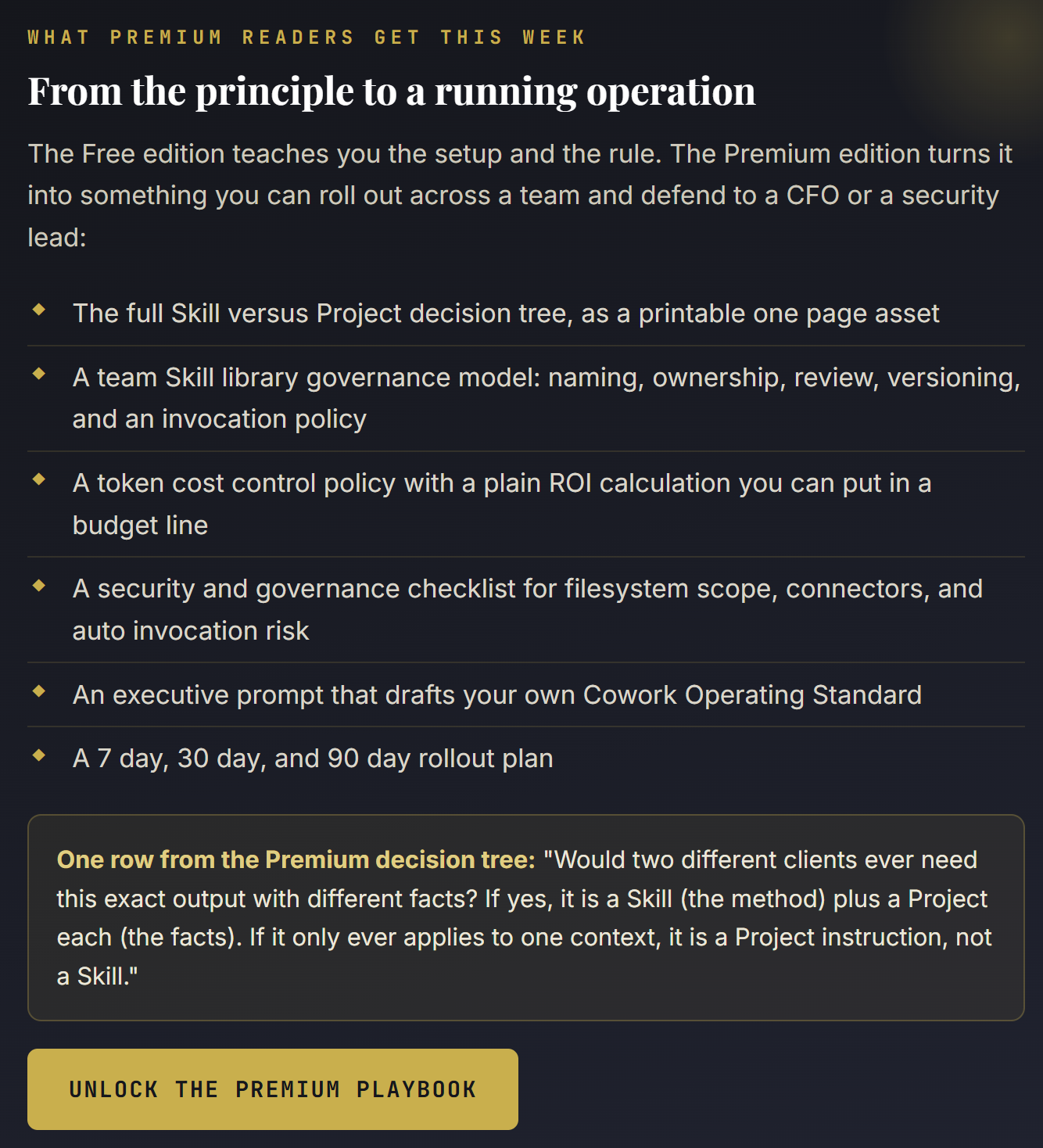
Pick the right candidate. Choose a task you repeat and could teach a competent colleague: a proposal format, a hook structure, a weekly report. If it is context about one client, stop, that is a Project, not a Skill.
Open the Skill creator. In Cowork, invoke the built in skill creator and let it interview you. Or paste this week’s Skill Architect prompt and answer its questions out loud.
Answer with your real method. Do not clean it up. Dump the actual steps, the tone rules, the traps. Messy truth beats tidy theory here.
Test it end to end. Invoke the new Skill by name on a real example. Watch where the output drifts from what you would have done.
Tighten the description. This is the field that decides when the Skill fires. Make it specific enough to trigger on the right requests and stay quiet on the wrong ones.
Save and share. Save the Skill, then share it to your workspace so teammates can invoke the same method, or hand them the Skill file directly.
Quality control checklist
The Skill has a unique, memorable name. The description would not fire on unrelated work. A teammate could run it without asking you anything. The output matched your standard on a real example, not a toy one.
Transfer it: the same discipline applies to Projects. One clean Project per real context, not one mega folder. And it applies to connectors: give the agent the narrowest access that still gets the job done.
AI Quiz
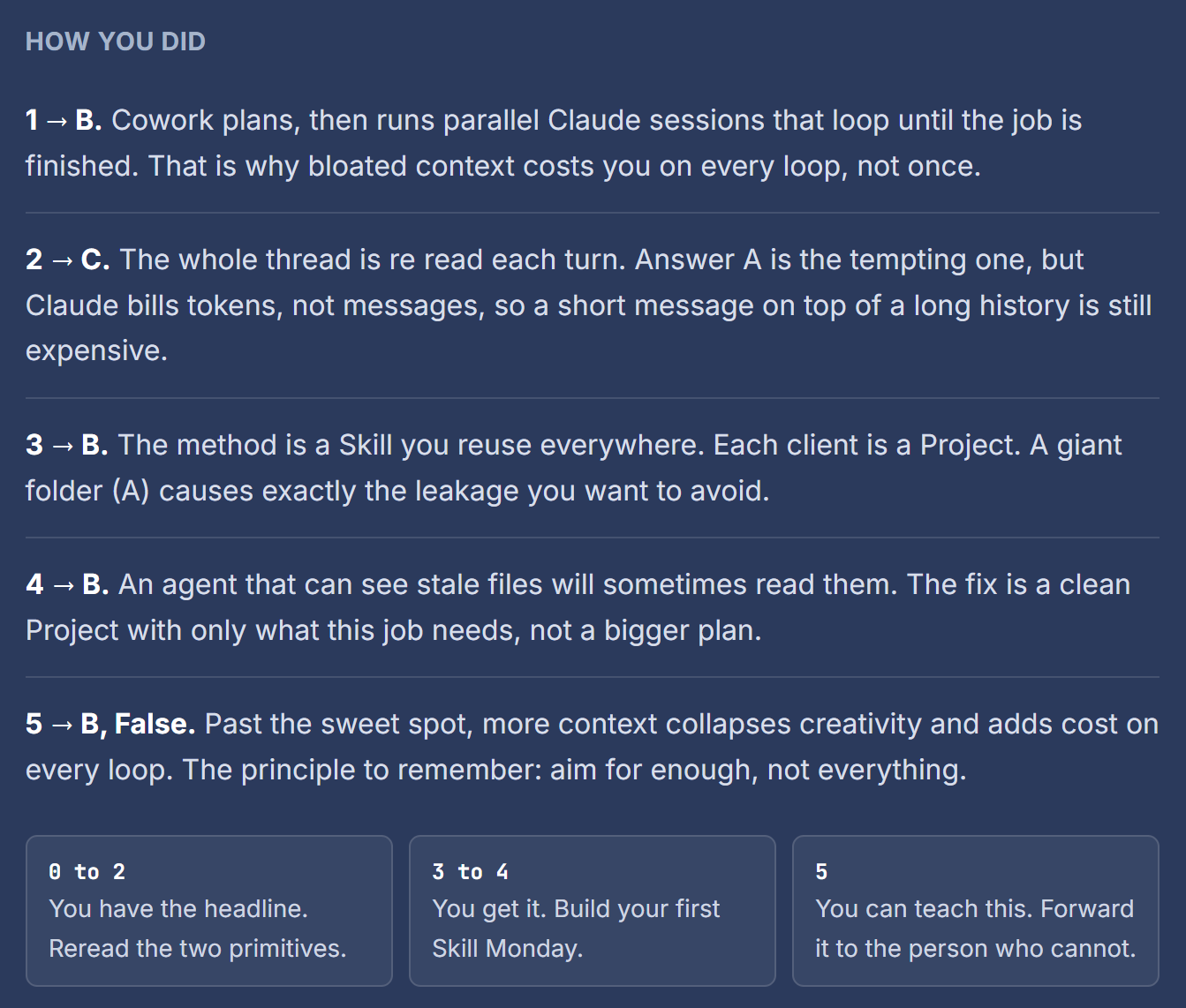
Five questions. Answers near the end.
1 · Understanding
When you hand Cowork a task, what does it do before answering?
A. Sends your prompt to a single model once
B. Plans, then runs several Claude sessions in parallel that loop until done
C. Waits for you to approve each word
2 · Mechanism
Why can a long chat thread cost more even when your latest message is short?
A. Claude charges per message
B. Longer threads use a pricier model automatically
C. The whole conversation is re read on every turn
3 · Application
You want Claude to draft proposals in your house style for many different clients. What do you build?
A. One giant folder with every client inside
B. A Skill for the method, plus one Project per client
C. A very long global instruction
4 · Scenario
Your agent keeps pulling last quarter’s numbers into new work. Most likely cause?
A. The model is out of date
B. Stale files in a shared folder are poisoning the context
C. You need a bigger plan
5 · The trick
True or false: adding more “about me” context always improves the output.
A. True
B. False
One Minute Challenge
Skill or Project?
Sort each item. One is the method you would teach anyone. The other is context that belongs to one situation. Answer revealed further down.
A · A way to turn any voice note into a structured brief
B · Everything about your client Beta: contracts, calls, past campaigns
C · Your standard format for a weekly board update
D · The full context of your Q3 product launch
Reply or comment with your four answers. Then check yourself below.
AI News, Curated
Three moves worth your attention
Cowork follows you across devices - EARLY JULY 2026 · ANTHROPIC - Cowork sessions and files now reach web and mobile in beta for the top usage plan, with wider access expected. Why it matters: long jobs now run in the background and ping you for decisions, which rewards clean setup and punishes bloated context that slows every loop.
The flagship model moves to metered credits - MID JULY 2026 · PRICING SHIFT - The opt in flagship now draws from a prepaid credit balance at roughly double the per token cost of the default agent model. Why it matters: token discipline stopped being abstract. Session hygiene and model routing now show up directly in what you spend.
Skills are an open standard, not a lock in - CONTEXT · STANDARD RELEASED LATE 2025 - The Skill format Anthropic released is open, and other agents have adopted it. Why it matters: a Skill you build for your team is portable know how, not a bet on one vendor. That changes the build versus buy math in your favor.
Tools That Earn Their Place
Three, chosen for usefulness
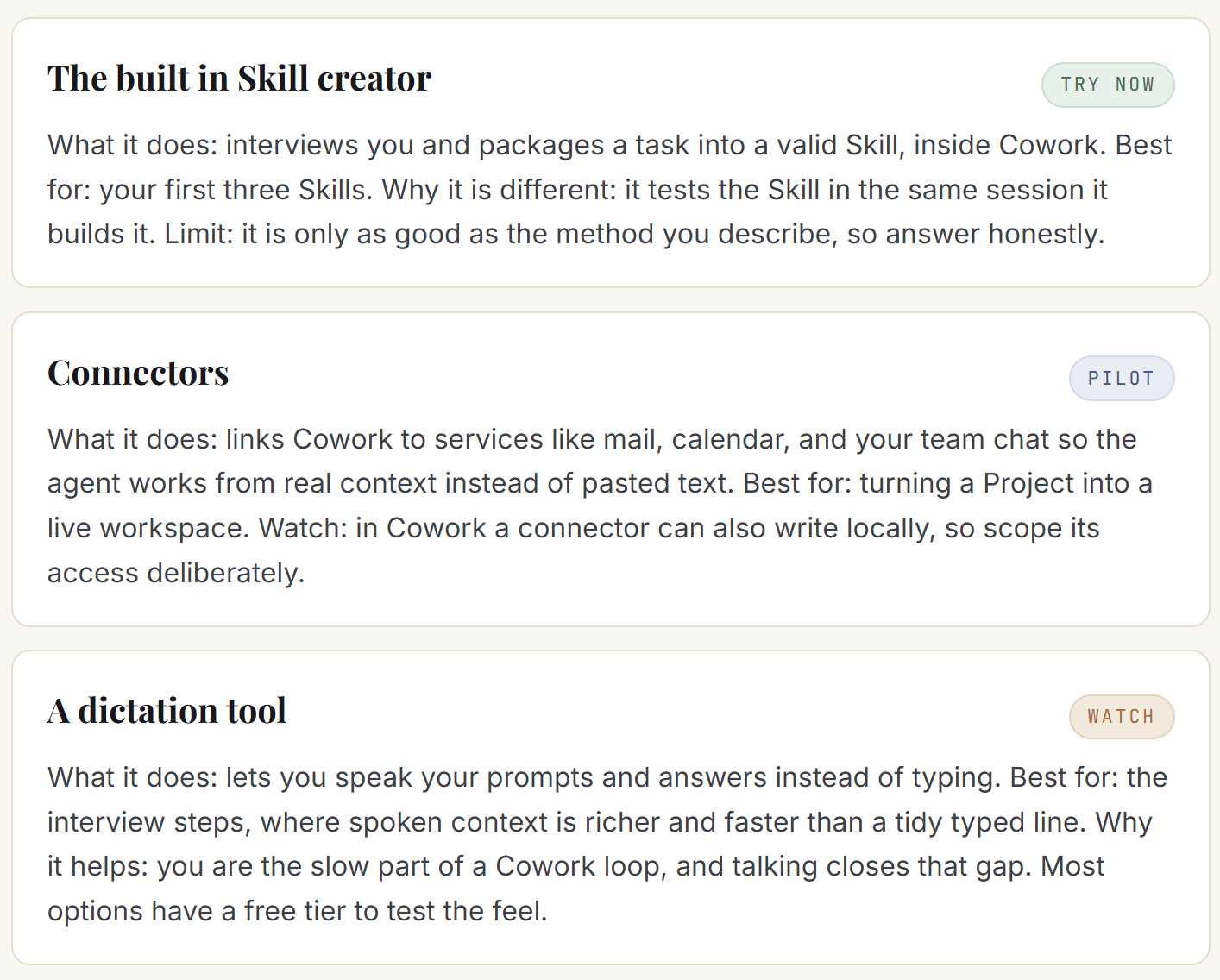
Tool of the Week · the Skill creator, in action
The task: turn your weekly status update into a repeatable Skill. Input: you answer six short questions about what a good update contains and the tone you want. Process: the creator drafts a Skill, you invoke it on last week’s real notes. Output: a clean update in your voice, in seconds, every week after. Why it beat doing it by hand: the method is captured once and reused, instead of re explained every Monday. When another tool is better: if the update needs live data from mail or your tracker, pair the Skill with a connector inside a Project.
Do This Monday
Trade one file for one Skill
Action
Open Cowork. Pick the one task you re explain most often. Build it into a Skill with the creator or this week’s Mega Prompt. Then delete or shrink one heavy “about me” file you were dragging into every session.
Time required
Under 30 minutes.
Expected result
One reusable Skill you can invoke by name, and one less pile of stale context slowing every loop. You will feel the difference on the very next task.
Quiz Answers & Result
Challenge answer
A and C are Skills: methods you could teach anyone. B and D are Projects: bodies of context tied to one situation. The lesson holds every time. If two different situations would use it with different facts, it is a Skill. If it only makes sense for one situation, it is a Project.
This briefing stays free because readers hand useful knowledge to their teams. If this issue saved you an afternoon of setup, forward it to one person who is still running Cowork off a folder full of files. That is the whole reason it stays open.
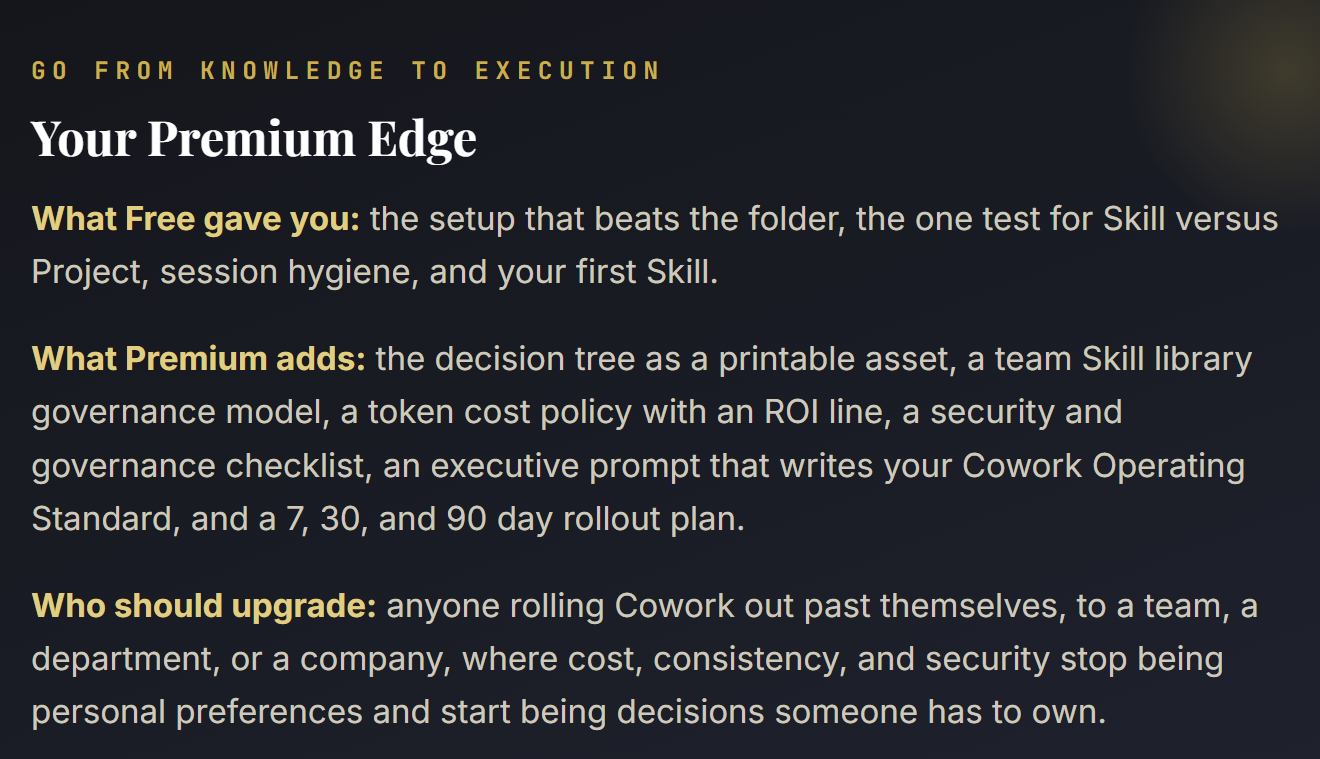
Go From Knowledge to Execution
Your Premium Edge
Sources
Anthropic Agent Skills documentation : platform.claude.com/docs/en/agents-and-tools/agent-skills/overview
Anthropic product news and Cowork updates : anthropic.com/news
Claude plan and pricing reference : claude.com/pricing
Cowork across web and mobile, reporting : techcrunch.com, pymnts.com (July 2026)
Cowork overview and general availability, independent guides (April to July 2026)
Research access note: prior editions were not available for a full redundancy check this week, so the anti repetition review is partial.
Free is good. Premium is a different instrument.
One upgrade pays for itself the first time the effort mapping saves you a model bill.
Still not sure? In the premium edition you will get access to 15+ AI deals worth $1,000+ in savings. It’s a mix of $50 credits, 10–30% discounts, and a few tools that are free to start; small wins that stack up fast.
Here some examples:
GetViktor — $50 off, Testimonial — 15% off for 12 months, Firecrawl — 10% off, Intellijend — 10% off for life, Cal.com — 20% off for 12 months, Dub — 20% off for 3 months, Guideless — 20% off for 3 months, Granola — first month free, Hundred Health — 10% off for 6 months, Anything — 20% off, Littlebird — $20 off, Supercut.ai — 10% off for 12 months, Kite — 10% off for 12 months, Cap — 20% off for 12 months, Beehive — 20% off for 3 months, Kick — 10% off for 12 months, Clico — 20% off, Peec AI — 33% off for 3 months.
Pass It On - Keep this free and independent.
Forward this issue and save them the surprise. The best place to send it is your team channel, where one link spares everyone the same mistake.
Video of the Week
Unlocking the Future of AI: Insights from Industry Leaders

Apur introduces a nine-week course focused on the evolving landscape of AI, emphasizing its economic implications and investment opportunities. He shares his background in engineering and investment, highlighting the importance of understanding AI’s profitability and market dynamics. The course features guest speakers from leading companies, aiming to equip participants with knowledge on where to invest and how to navigate the AI ecosystem. Apur encourages active participation, asserting that the insights gained will be invaluable as AI continues to reshape industries. Watch the video
Whitepaper of the Week
AI’s next major bottleneck is not intelligence; it is electricity.

In Q1 2026 alone, at least 75 US data-center projects worth approximately $130 billion were blocked or delayed.
71% of Americans now oppose an AI data center being built in their local area.
The IEA expects global data-center electricity consumption to double to roughly 945 TWh by 2030.
This will not end the AI boom, but it could end the era of endlessly available, increasingly cheap compute, hitting cloud-dependent mid-sized businesses first.
TL;DR: Stop treating AI like infinitely scalable software; optimize model routing, control inference costs, and reduce provider dependency before compute becomes your next margin crisis.
👉 Upgrade to Digital Storm Premium for a deep dive into this. No time to read? Then listen our Podcast while you are driving or in the Gym, powered by Wondercraft.
Try Premium free for 7 days + get 20% off your gateway to insider AI insights, audio editions, and expert analysis.
🔗 Subscribe now to Digital Storm Premium
Trending Tools
ClawTeams - The first goal-driven, proactive AI team for e-commerce
Pazi - Vibe code business operations
Paradigm - Turn any goal into a personalized, adaptive learning path.
AgentKey - One-stop live data marketplace for your agent
V2Fun - Generate 3D character with 8K textures and AI motion capture
Osaurus - Open source agents that run 100% locally on your Mac
Velo 3.0 - AI video infrastructure to explain, train, and sell faster.
Unabyss for Claude - Shared memory across all apps and LLMs. In Claude
Goose Ads Remixer - Remix the ads already winning in your niche
The remaining ten find in Premium Version
My personal Favourites:
Create a studio-quality podcast or audiobook in minutes with Wondercraft AI and hear it in action on the new Digital Storm Premium Podcast, upgrade here:
Headlines you should know
Generative AI Is an Engineering Disaster - As AI companies scramble to keep their systems online, the costs are rising for consumers. Large language models are becoming increasingly expensive to maintain... Read more
Experts Praise Hawaii’s New Laws on Abusive Use of Generative AI - New legislation in Hawaii aims to protect individuals from harmful deepfakes created without consent, receiving positive feedback from experts in the field... Read more
Microsoft’s Generative AI Leadership Is ‘Clear,’ Morgan Stanley Says - A recent report highlights Microsoft’s dominance in the generative AI space, with increased spending on Azure and Microsoft 365 by CIOs... Read more
Please Stop Making Me Opt Out of AI - The article argues for a shift from “opt-out” to “opt-in” settings for generative AI features, emphasizing user consent and control... Read more
BigBear.ai Launches Expanded Generative AI Platform for Department of War Missions - The defense technology company unveils new capabilities aimed at enhancing military operations through generative AI... Read more
New Survey Claims 100% of Japanese Online Game Developers Use Generative AI Tools - A recent report reveals that all surveyed Japanese online game developers are utilizing generative AI tools in their projects... Read more
Netflix Says Around 300 Titles Used Generative AI - In its latest earnings report, Netflix disclosed that approximately 300 of its titles incorporated generative AI technology this year... Read more
Star Wars Creator Embraces the Dark Side, Argues for AI in Filmmaking - George Lucas advocates for the integration of generative AI in the filmmaking process during a recent interview... Read more
Viral Friendslop Game Dear Passengers Faces Backlash for Epstein Jokes and Generative AI - The game has sparked controversy due to its use of generative AI to create jokes about sensitive topics, leading to mixed reactions... Read more
AI Meme of the week
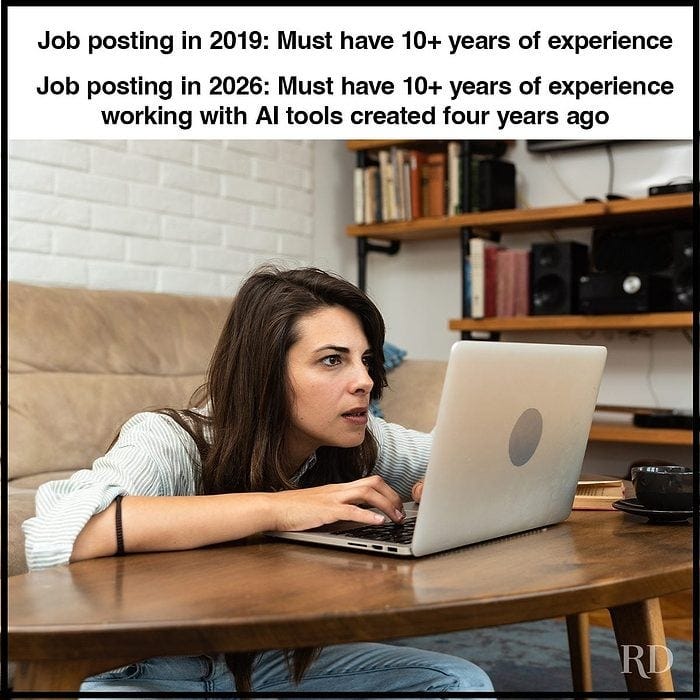
AI or not???
This was the last quiz. 60% answered “Real” - correct!
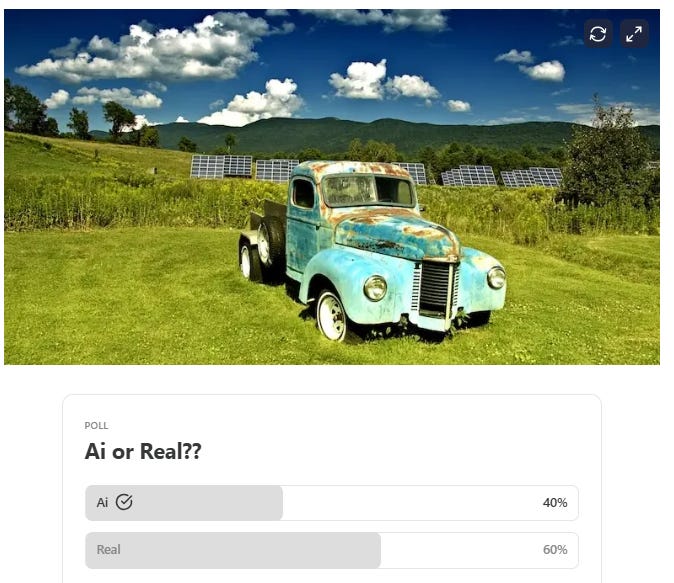
Can you answer this one?

To my dear Linkedin Readers: Sorry this only works on the Substack Newsletter - Subscribe here - it’s also free, but much better
💡 Enjoyed this edition? Share it with your network. Your support helps us keep this newsletter free and growing.
- Share - Share - Share - Share - Share - Share - Share - Share - Share - Share - Share -
We’d love to hear from you!
How did you like todays brief? Your feedback helps us improve and deliver the best possible content.
Tell us areas for improvement please - We appreciate your feedback. Thanks alot!
To my dear Linkedin Readers: Sorry this only works on the Substack Newsletter - Subscribe here - it’s also free, but much better
Knowledge Base
New cheatsheets uploaded - check them out:
Got questions? My AI has answers. Ask anything to my 24/7 digital brain trained on this newsletter & all our Linkedin posts
Welcome Package for Subscribers (50,000+ ChatGPT Prompts, 9,000+ Free AI Tools, 1,000+ Picture generator prompts, Growth hacks for Startups & SaaS etc. etc. ➡️ »»»click here«««
Find 100+ AI eBooks, cheatsheet, prompt guides »»»click here«««
Full Access to existing eBooks, Cheatsheets, Prompt guides,… »»» click here «««
Partner with “Digital Storm Weekly”
Reach 1.5M+ decision-makers. Drive growth. Build trust.
Join leading companies like NVIDIA, AWS, Alibaba, HubSpot, Redhat, Huawei, EY and alot others who trust Digital Storm Weekly to showcase their products to an engaged, tech-savvy audience.
600,000+ newsletter readers
1.5M+ LinkedIn followers (including execs from top startups & Fortune 500s)
Newsletter published on Substack & LinkedIn (Dr. Storm & Paul Storm & Lucas Storm )
How we help:
Brand Campaigns: We promote your product through high-impact campaigns across our newsletter and LinkedIn, reaching senior decision-makers at scale.
AI & Strategy Consulting: We help SMEs, and enterprises turn AI into business results; from ideation and use-case definition to real implementation across workflows, products, and teams.
LinkedIn Growth on Autopilot: We run your LinkedIn end-to-end: strategy, positioning, content, design, and posting; helping you grow followers, attract customers, and build a credible personal or company brand without daily effort.
📩 Let’s collaborate: Email: digitalstormweekly@gmail.com
We read your emails, comments daily. Hit reply and let us know what you want more / less of! - Email: digitalstormweekly@gmail.com
Joerg (Follow: Linkedin) & Paul (Follow: Linkedin)
Have you missed any past newsletter? Check them out here:
Digital Storm, Europe’s executive influence platform.
Independent commentary. Not affiliated with or endorsed by Anthropic. Prices, availability and model behavior verified against sources on the publication date and may change. Nothing here is legal or financial advice. The signal, not the noise.
We take the responsibility of emailing you seriously. If you don’t want to receive this newsletter anymore, you can unsubscribe at any time.
Unbounded state expansion is an engineering disaster 💥. Most agent setups treat context like a storage locker. They stuff company profile files, style guides, and past outputs into a shared directory, expecting magic. It fails because transformer memory doesn't work like human memory 🧠.
Every loop in a multi-agent workflow is an active computation. Streaming heavy static files through KV caches on every iteration triggers severe cache thrashing. Latency spikes. The model's creative output collapses into generic average responses because the prompt distribution is diluted by noise 📊.
Sovereign execution requires strict mathematical boundaries 🛡️. Decouple the *how* from the *what*. A capability should exist as an isolated, portable primitive loaded only upon invocation. A context container should bind strictly to one task scope without leaking 🔒.
Instead of paying a continuous token tax on cloud APIs, why aren't we compiling these capability primitives into deterministic hardware gates on local NPUs? 🤖 Are you directing your agent, or just paying for its context noise?
(⚡_⚡)