

The Dropdown Is Now a Control #174b
Three variables collapsed into one choice this week: what your AI costs, how good it is, and where your data sleeps. Almost no organisation has assigned an owner to it.
Signup
We are honored to count you among the >600.000 readers of “DIGITAL STORM weekly”. Please help grow our community by inviting your friends.
Executive Summary
Five sentences
The Big Shift
Capability stopped being the scarce input
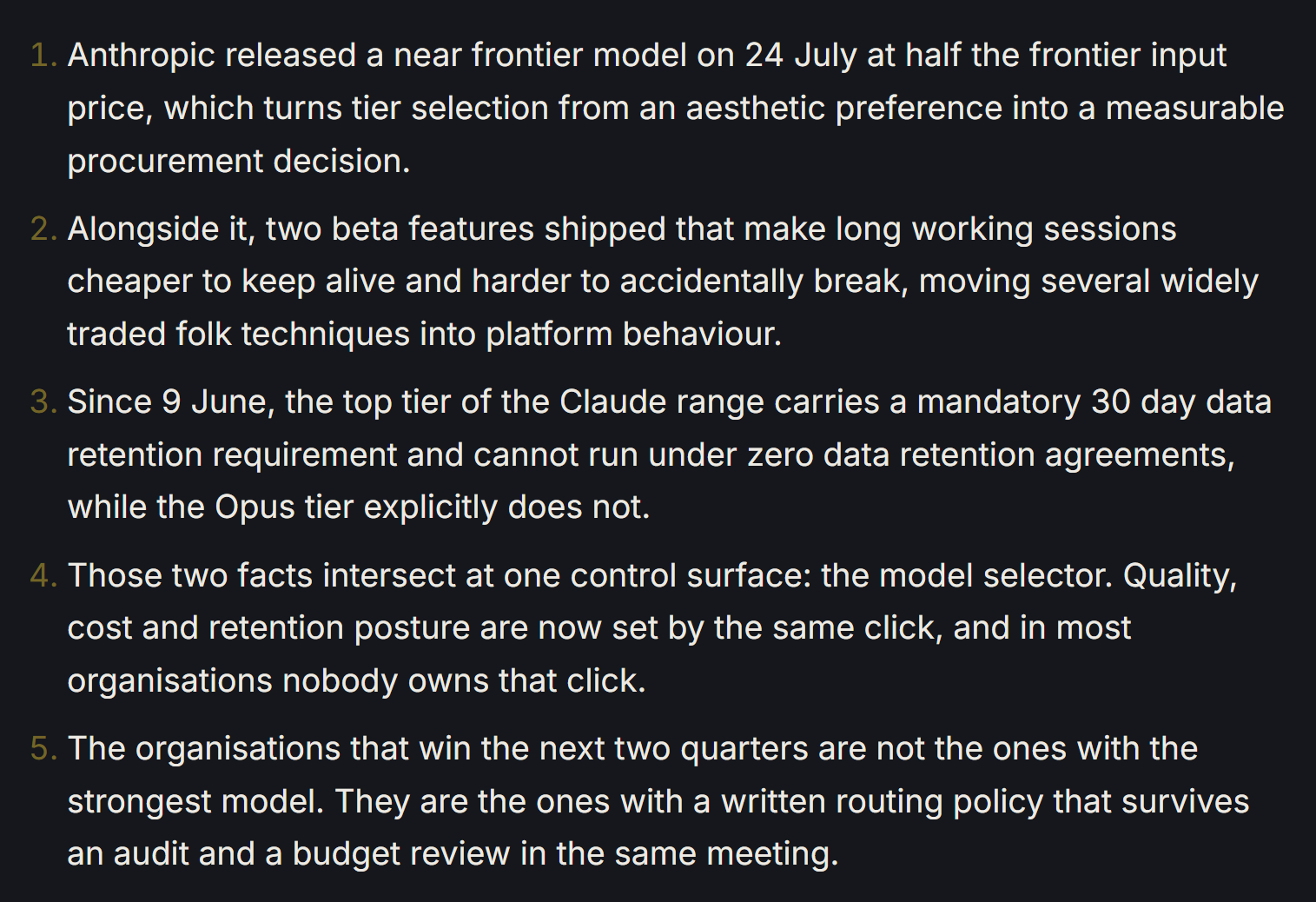
For three years the operative question was can the model do it. That question is closing. On Anthropic own evaluations, Opus 5 lands within half a percent of the frontier model on CursorBench 3.2 at maximum effort while costing roughly half per task, and beats the frontier model on OSWorld 2.0 at just over a third of the cost. Independent verification will take weeks and should be waited for, but the direction is not ambiguous: the capability gap between tier two and tier one is now narrower than the price gap between them.
When capability stops being scarce, the scarce input becomes judgement about allocation. Which task gets which tier. Which conversation stays open. Which data is permitted to touch which model. This is a familiar transition for anyone who has run infrastructure: the moment compute became cheap, the discipline moved from provisioning to placement.
The executive mistake available right now is to treat this as a cost optimisation exercise and hand it to procurement. It is not. Routing decisions determine output quality and regulatory exposure at the same time, which means the policy has to be owned somewhere that can see all three.
Premium Intelligence · Technical Mechanism
What is actually being billed
Layer 1 of 5
The Free Edition explains that conversations are re read every turn. Here is the layer beneath that, which is where the money is.
